 Skip to content

Roughly 80% of a typical household’s take-home pay vanishes before you even think about a vacation or a night out. Housing, groceries, and basic transportation swallow your monthly income whole. That jarring number explains why a clear budget rule isn’t just helpful-it’s a lifeline.
The 50-30-20 rule, introduced by U.S. Senator Elizabeth Warren and her daughter Amelia Warren Tyagi in their 2005 book All Your Worth, cuts through the noise.
It doesn’t demand that you track every dollar with painful precision. It simply splits your net income into three main categories. You dedicate roughly 50% to needs, 30% to wants, and the remaining 20% to savings and debt. The framework was built for families who felt crushed by their bills and needed a way to start breathing again.
I’ve been there personally. Years ago, my credit card statements read like a novella of bad choices, and my “budgeting method” was crossing my fingers. The elegance of this system is that it gives you a guideline, not a prison sentence.
A household pulling in $5,000 a month after taxes aims to cap needs at $2,500. But the moment your rent or personal finance obligations arise. cost of living pushes that needs and wants balance out of whack, you need to adjust.
That’s exactly what we will tackle here.
- How to tell a true “need” from a sneaky “want” when managing your expenses
- A dead-simple way to split your paycheck without complex budgeting systems
- Practical tweaks like the 60/10/10/20 split when your rent exceed 50% of your pay
- Why automating your savings over time protects your future self
We will walk through three categories-must-haves, fun money, and your future fund-so your money is going exactly where you want it. This is not about cutting out joy. It’s about building a monthly budget that actually sticks, so you can finally stop worrying and start living with peace of mind.
Your Money’s Home: What the 50-30-20 Rule Really Means
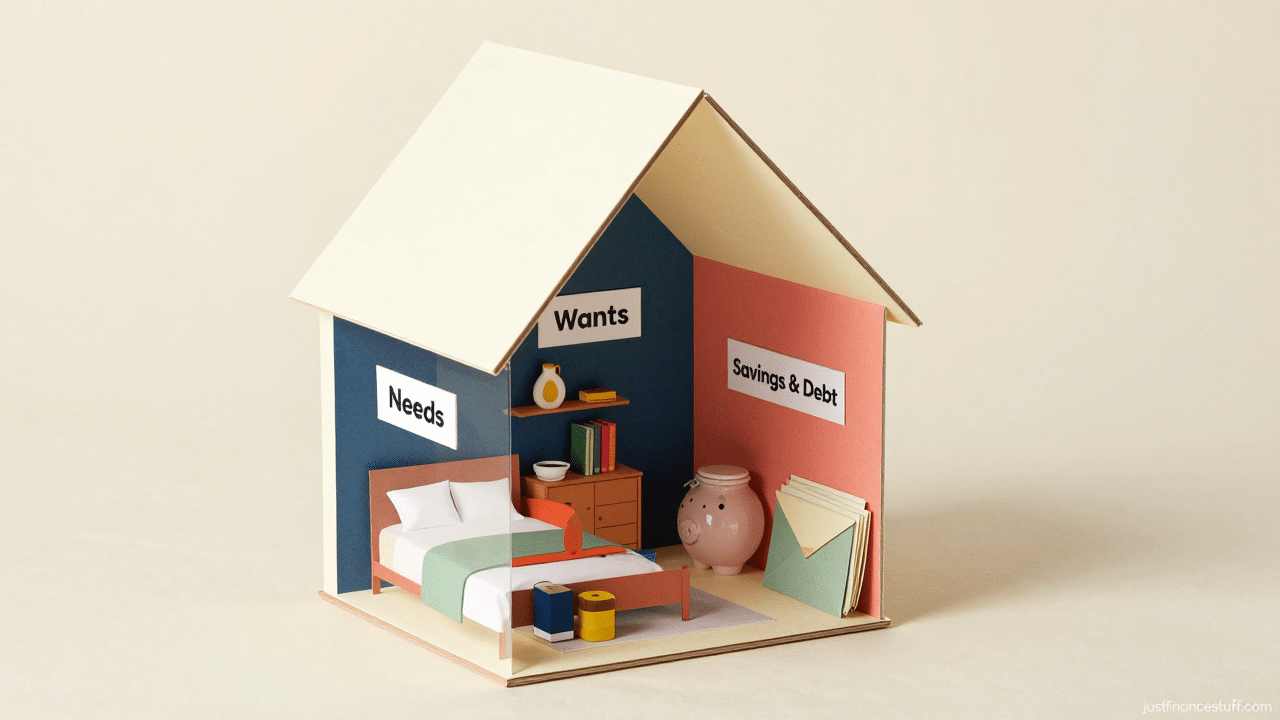
Think of your paycheck as a house with three rooms. Most budgeting systems give you a dozen tiny closets and ask you to track every dollar. This one doesn’t. The 50-30-20 rule splits your net income into just three main categories-needs, wants, and savings-so you always know where your money is going without drowning in detail.
You start with your take-home pay. That’s the cash that hits your bank account after taxes, health insurance, and any other deduction your employer pulls out. Not your salary.
Not your gross pay. The number on your deposit slip.
For a $5,000 monthly income, half-$2,500-covers your needs and helps you manage your money. Another $1,500 funds your wants. The remaining 20%, or $1,000, goes toward savings and debt repayment beyond minimums, helping you plan your budget effectively.
“The 50/30/20 rule was designed to simplify budgeting, especially for families struggling to manage their spending.”
– Elizabeth Warren & Amelia Warren Tyagi, All Your Worth: The Ultimate Lifetime Money Plan (2005)
I used to drown in credit card statements that made no sense. Splitting expenses into three piles changed that. You don’t need a budget calculator or fancy software to categorize what you spend.
Look at your bank app. Scan last month’s transactions.
Ask one question about each line: is this something I must pay to live and work? That’s a need. Is it optional but joyful?
That’s a want. Is it building my future?
That’s savings or debt repayment.
The 2023 typical U.S. household earned roughly $88,000 after taxes. Apply the 50-30-20 rule and needs should cap at $3,667 monthly. Reality bites harder. The average household actually spent over $4,200 per month on housing, groceries, healthcare, and transportation alone.
That math doesn’t work. And that’s exactly why this budgeting method is a flexible guideline-not a prison sentence.
| Monthly Take-Home Pay | 50% Needs | 30% Wants | 20% Savings/Debt |
|---|---|---|---|
| $3,000 | $1,500 | $900 | $600 |
| $4,000 | $2,000 | $1,200 | $800 |
| $5,000 | $2,500 | $1,500 | $1,000 |
| $6,000 | $3,000 | $1,800 | $1,200 |
Here’s what surprises people new to budgeting: the 20% bucket does double duty. Part of it builds your emergency fund in a separate savings account. Part of it attacks credit card debt, student loans, or any balance eating at your peace of mind.
Minimum debt payments live in the needs category. The extra payments you throw at principal?
That’s the 20% rule explained at work.
Next we’ll unpack what actually belongs in each room. Spoiler: that daily latte and your subscriptions to streaming services aren’t both in the same bucket, and understanding why will change how you see every dollar you spend.
When you ignore how much your basics truly cost, you drift. I learned that the hard way years ago, staring at a stack of credit card statements that told a story I didn’t want to read. The math was unforgiving: my rent, my utility bills, and the bare-minimum expenses you need to create a budget. debt payments had swallowed almost my entire paycheck. I felt stuck, but that moment of honesty was the first real way to start fixing things.
Housing costs consume 40-50% of take-home pay for most working Americans as of June 14, 2026. Groceries are up 30% since 2021. This isn’t a personal failing-it’s the current cost of living. Your 50% bucket must hold the expenses you truly cannot skip without serious consequences.
Think shelter, basic food from the grocery store, the electricity that keeps your fridge running, and the medicine that keeps you healthy. It also includes the ride to work and the minimum payments on your student loans or credit cards.
The line between a need and a “want” gets blurry fast. A new pair of work shoes because your old ones have holes? That’s a need.
A third pair of trendy sneakers because they were on sale? That’s a want you’ll categorize later.
A basic phone plan to stay in touch can be a need, but three separate subscriptions to streaming services are not. Your childcare cost is a non-negotiable need if it allows you to earn a living. These distinctions are the engine of your money management system.
The official rule asks you to cap these costs so they don’t exceed 50 percent of your net income. For many, that’s a genuine challenge. The average household spent over $4,200 per month on housing, groceries, healthcare, and transportation in 2023.
If your basics eat up 60% or 70% of your pay, that doesn’t mean you’ve failed. It shows you where you need to adjust the guideline to match your real life, which we’ll get into later.
Start by looking at where your money is going right now. Pull up your bank app and read through one month of transactions. You’ll likely spot surprises-a forgotten subscription hiding among the essentials, or a grocery bill bloated by impulse buys.
Every dollar you free up from this category isn’t just a penny saved. It’s ammunition for your financial goals, breathing room for fun, and a down payment on peace of mind.
| Common Need | What It Includes |
|---|---|
| Housing | Rent or mortgage payment |
| Utilities | Electricity, water, gas, basic internet |
| Groceries | Basic food items, not restaurants |
| Transportation | Car payment, gas, or bus pass |
| Healthcare | Insurance premiums, prescriptions |
| Minimum Debt | Smallest required debt repayment |
Getting this category under control is the hardest part of any budgeting method. Yet it’s also the most rewarding. The goal isn’t to live a grim, joyless life. It’s to make sure your shelter, your food, and your basic safety don’t own 80% of your every dollar before you even get to choose how to spend money.
Your Fun Money: What Fits into 30% “Wants”?
That 30% slice is where most budget debates begin. It covers everything you enjoy but would not buy to stay alive. The category is broad-and that is both its gift and its trap. You get freedom here, but freedom without a fence turns into chaos fast.
Wants are non-essential expenses that enhance your lifestyle. Dining out, concert tickets, the latest phone, that third streaming service, hobby gear, weekend trips, non-essential clothing, and fancy coffee all land here. Rachel Cruze, a #1 New York Times bestselling author and financial expert, argues that 30% for wants is too high if debt repayment is a priority. She has a point. If you are carrying credit card balances, every dollar spent on takeout is a dollar not attacking interest.
The line between a need and a want is not always sharp. You need food-but you do not need restaurant food. You need transportation-but you do not need a brand-new SUV.
A simple test: if you lost your income tomorrow, which expenses in the three categories would you cancel first? Those are your wants.
Your credit card statements and bank records tell the truth here, even when your brain wants to argue.
Why This Category Matters More Than It Looks
The 30% bucket is where lifestyle inflation hides. A raise arrives, and suddenly more dinners out and upgraded subscriptions feel like needs. They are not.
Bureau of Labor Statistics data from March 10, 2026, shows that households earning over $150,000 allocate roughly 28% to wants-close to the guideline. Lower-income households often blow past it because the category is easy to lose track of.
A recent trend called “loud budgeting” encourages people to openly discuss financial limits and opt out of expensive social activities. Instead of pretending you can afford the group trip, you say it plainly: “That is not in my budget right now.” The practice removes shame and makes sticking to your plan easier. It also reveals who respects your boundaries-and who was just using you to split the bill.
| Expense | Need or Want? | Why |
|---|---|---|
| Basic groceries | Need | Required for health |
| Restaurant dinner | Want | Convenience, not survival |
| Internet service | Need (for work) | Depends on your job |
| Netflix + Hulu + HBO | Want | One subscription may be enough |
| New winter coat (old one ripped) | Need | Protects from cold |
| Designer winter coat | Want | Brand markup is a choice |
Control does not mean elimination. It means deciding in advance how much you allocate to fun. Set a dollar figure.
When it is gone, it is gone. That constraint forces creativity-and oddly, it can make enjoyment sharper because nothing is mindless anymore.
The 20% bucket you will read about next only works if this 30% stays in its lane. One overgrown category starves the others.
Your Future Fund: The 20% for Savings and Debt
Some people treat savings like a suggestion. Others treat it like a bill they must pay first. The second group wins-every time.
If you wait to see what is left over at the end of the month, the answer is usually nothing. That is why the 50-30-20 rule makes you allocate this remaining 20 percent before anything else sneaks in.

This slice of your monthly income does two jobs at once. It builds your future and cleans up your past. Every dollar here goes either toward savings or toward crushing debt faster than the minimum asks.
Skip this step, and you stay stuck. Own it, and your money starts working for you instead of chasing you.
What Actually Belongs Here
Not all debt payments count. Your minimum credit card bill? That is a need-it lives in the 50 percent bucket.
The extra payment you throw at the balance to kill it sooner? That goes here.
Same logic applies to student loans and car notes. Minimums keep the lights on. Extras buy your freedom.
On the savings side, think in layers. Layer one is your emergency fund-a stash of cash that catches you when life trips you. Medical surprises, a busted transmission, a sudden job loss.
Without it, you borrow. With it, you breathe.
Layer two is retirement money: 401(k) contributions, an IRA, anything that grows while you sleep. Layer three is financial goals with a name-a down payment, a wedding, a year of childcare saved in advance.
“The 50/30/20 rule doesn’t prioritize saving over wants and doesn’t help pay off debt faster.”
– Rachel Cruze, financial expert and bestselling author
20 percent may not be enough if your debt is aggressive. Carrying high-interest balances eats your future faster than saving builds it. In that case, you need to adjust. Push the percentage higher temporarily.
Raid your wants category. Do whatever it takes to stop the bleeding-then return to the guideline when the weight lifts, you’ll feel the relief of managing your money better.
Make It Automatic (Or It Will Not Happen)

Willpower fails. Systems do not. Set up an automatic transfer from your checking account to a separate account to help you save. savings account the day after your paycheck lands.
You cannot spend what you do not see. Some budgeting systems let you split your direct deposit so the 20 percent never even touches your spending account.
That is the cleanest way to budget for your future self.
| If Your Monthly Take-Home Pay Is | Your 20% Savings and Debt Target Is |
|---|---|
| $3,000 | $600 |
| $4,000 | $800 |
| $5,000 | $1,000 |
| $7,000 | $1,400 |
Treat this percentage of your income like rent you owe to your own future. Pay it first. Pay it always. The rest of your budget bends around this commitment-not the other way around.
Where People Get Stuck
The danger zone is mixing your savings and debt money with your everyday checking balance. One quiet weekend, a few taps on your phone, and suddenly your emergency fund bought concert tickets and dinner. Separate accounts are not optional here. They are the wall between today’s impulses and tomorrow’s peace of mind.
Another trap: treating 20 percent as the ceiling. For some, it is the floor. If you are paying down debt with double-digit interest rates, or you started saving for retirement late, or you live in a city where the cost of living already stretched your 50 percent needs beyond its limit-then 20 is just the starting line.
Push harder when you can to get out of debt. Your savings over time compound quietly, but they compound loudly when you give them more fuel early.
Households earning over $150,000 allocate roughly 30% to savings and debt repayment. That is not an accident. Higher incomes make it easier to compress needs, but they also reveal a truth: the wealthiest future selves are built by the people who treated this category as non-negotiable from day one.
Making It Work: Adjusting the 50-30-20 Rule for You
Five years ago I sat with a spreadsheet and realized my needs ate 78% of my take-home pay. The 50-30-20 rule laughed at me from the corner. I felt like a failure. Then I figured out the secret nobody tells beginners: the percentages are a starting line, not a finish line.
The 50-30-20 rule was born in 2005. Elizabeth Warren and her daughter wrote about it when housing was cheaper. Groceries hadn’t spiked 30% since 2021.
The math worked differently back then. Today, housing alone grabs 40-50% of most working Americans’ take-home pay.
You aren’t bad with money. The old numbers just don’t match your reality.
Osama Alam, writing on June 14, 2026, called the rule outdated for exactly this reason. He pointed out that needs now consume 60-70% of take-home pay for most households. The original framework assumed stable prices. That assumption collapsed. So blaming yourself for not hitting 50% makes zero sense.
“Any budget you actually stick with beats a perfect budget you abandon.”
– Common sense, backed by every financial coach I know
When the 50% Needs Cap Breaks
Run your own numbers before you adjust anything. Grab your last three credit card statements. Circle every essential cost.
Rent. Utilities.
Childcare. Minimum debt payments. Groceries.
Insurance. Transportation.
If that total pushes past 60% or even 70% of your net income, you are normal-not reckless.
Households earning over $150,000 allocate roughly 42% to needs, according to Bureau of Labor Statistics data from March 10, 2026. Higher income compresses the needs category naturally. That same data shows these households put 30% toward savings and debt-way above the standard 20% guideline.
The rule fits them because their numbers allow it. Your numbers might not.
That’s okay.
Three Ways to Bend the Rule Without Breaking It
Stop hunting for the perfect budgeting method and start with one you can sustain to help you save. Here are three adaptations that work when 50-30-20 doesn’t:
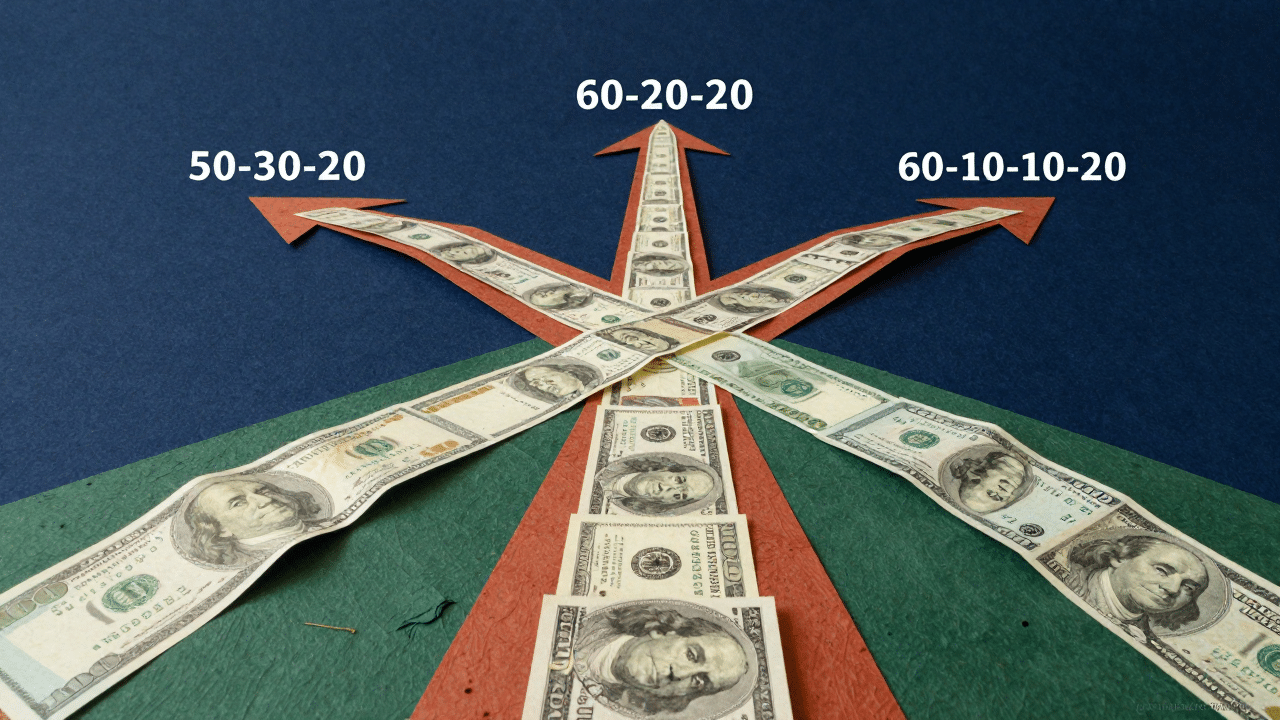
- 60-20-20 split. Shift 60% to needs if housing or childcare dominate your monthly budget. Keep 20% for wants. Keep 20% for savings and debt. This preserves the saving habit without punishing you for high essential costs.
- 70-20-10 split. Allocate 70% to essentials when costs are simply that high. Direct 20% to wants. Send 10% toward savings and debt. Ten percent toward savings beats zero percent every time. Start here and increase later.
- 60-10-10-20 split. Alam’s proposed 2026 formula breaks things differently. Put 60% toward needs. Dedicate 10% to investments. Attack debt with another 10%. Leave 20% for lifestyle. This separates investing from debt destruction-two very different financial goals-instead of cramming both into one bucket.
What Actually Matters More Than the Percentages
The goal isn’t perfect categorization. The goal is knowing where your money is going. Many households see needs consume about 80% of take-home pay.
If that’s you, the standard rule isn’t a challenge to meet. It’s permission to adapt.
Try this instead: pick one of the three adjusted splits above to create a budget that works for you. Use a budget calculator to test which one fits your actual net income. Track your spending for 30 days.
Then need to adjust again. Budgeting systems survive on flexibility, not rigidity.
The 70-20-10 approach works better for some people than 60-20-20. Test both.
What kills financial progress isn’t using the wrong split. It’s freezing up because the original 50-30-20 rule doesn’t fit. Pick your adjusted numbers.
Move on. Sticking to a budget that reflects your real life beats staring at a guideline you can’t use.
Conclusion
The 50-30-20 rule is not a perfect formula. It is a starting point – a simple guideline to help you see where your money is going. Senator Elizabeth Warren and her daughter created this budgeting method to make money management less scary for families who felt lost.
You split your take-home pay into three main categories: needs, wants, and savings and debt. That clarity alone changes how you make financial decisions.
79% of American households now spend more than 50% of their net income on needs alone. Housing costs eat up 40-50% of take-home pay for most working families. Groceries jumped 30% since 2021. The original rule assumed you could cap needs at half your pay.
For many of you reading this, that math feels impossible. Budgeting systems fail when they ignore your real cost of living.
The rule only works if you treat it as a flexible budgeting approach, not a rigid command.
“Budgeting isn’t about restriction – it’s about clarity. When you know where every dollar goes, you stop wondering if you can afford the life you want.”
– Rachel Cruze, Financial Expert and Author
What to remember
- 50% for needs is a target, not a sentence. Many households exceed 50%. Households earning over $150,000 allocate roughly 42% to needs. Lower-income families often hit 60-70%. Adjust the percentages to fit your real numbers.
- The 20% savings and debt category does double duty. It covers your emergency fund, retirement, student loans, credit card payments above the minimum, and any savings goal. If you carry heavy debt, 20% won’t cut it. Boost that number temporarily.
- “Wants” are not the enemy. Streaming services, a weekend trip, dinner out – these make life enjoyable. The rule gives you permission to spend money on them. Guilt-free. You just keep them inside the percentage you set.
- Lifestyle inflation is silent and real. As your monthly income grows, your wants and needs expand to match unless you consciously allocate raises toward savings and debt repayment. The rule helps you avoid that slow drift.
- There are other paths. A 60-10-10-20 split (needs, investments, debt destruction, lifestyle) or a 70-20-10 budget might work better if you are paying down debt fast or living in a high-cost area to manage your money effectively. The best budgeting method is the one you stick with.
Your next step today

Open your last three credit card statements and your bank app. Categorize every single expense into needs, wants, or savings and debt. Do not judge yourself – just see the numbers.
Calculate your total monthly income after taxes and deductions. Then apply the percentages.
If needs exceed 50%, do not panic. Adjust the wants percentage down, or accept a 60-30-10 split for a season. Set up an automatic transfer to a dedicated savings account for the remaining 20 – 30% – even $50 a month builds savings over time and creates peace of mind.
Your budget is a living document. Adjust it. Break it.
Fix it. The point is not perfection – it is awareness that leads to better financial decisions and real control over your money.