Investing Make Rich
Can investing make you rich is a common question. This guide explains how stocks build wealth over time, the role of compounding, and practical steps you can take today. You’ll find straightforward explanations, concrete examples, and clear actions to start investing wisely.
Why investing is a long-term wealth strategy
Most people become wealthier by investing regularly over many years. The stock market tends to rise over time, so staying invested helps you benefit from growth while smoothing out short-term swings.
Common myths vs. reality
Myth: investing makes you rich overnight. Reality: wealth grows slowly but steadily with time and discipline.
Myth: you need to pick a few hot stocks to succeed. Reality: a diversified approach often protects you from big losses.
Myth: stock investing is only for experts. Reality: with the right foundation and simple strategies, beginners can start investing safely.
Concrete steps to start investing today
1) Set a monthly amount you can invest. For example, if you earn $4,000 after tax, start with $200 per month and increase as your budget allows. 2) Open a low-cost brokerage account and choose broad index funds or ETFs that cover large portions of the market, such as a total stock market fund or a global equity fund. 3) Automate contributions on the same day each month so you don’t forget. 4) Reinvest dividends automatically to harness compounding. 5) Review your portfolio twice a year and rebalance if one region or sector becomes too dominant.
Simple, practical scenarios
- Young professional starting at 25: invest 15, 20% of take-home pay into a broad market ETF, aiming for a 7, 8% annual return over decades.
- Mid-career saver with a family: allocate 60% to diversified stocks and 40% to bonds to reduce risk while preserving growth potential.
- Near-retirement at 60: shift to more conservative funds with shorter duration bonds and high-quality dividend stocks to provide income.
Common pitfalls to avoid
Don’t try to time the market or chase last year’s winners. Avoid excessive trading that eats into returns with fees and taxes. Beware over-concentration in a single sector or company, especially if you’re new to investing. Always confirm expense ratios and remember that past performance is not a guarantee of future results.
The power of long-term compounding
How compounding works
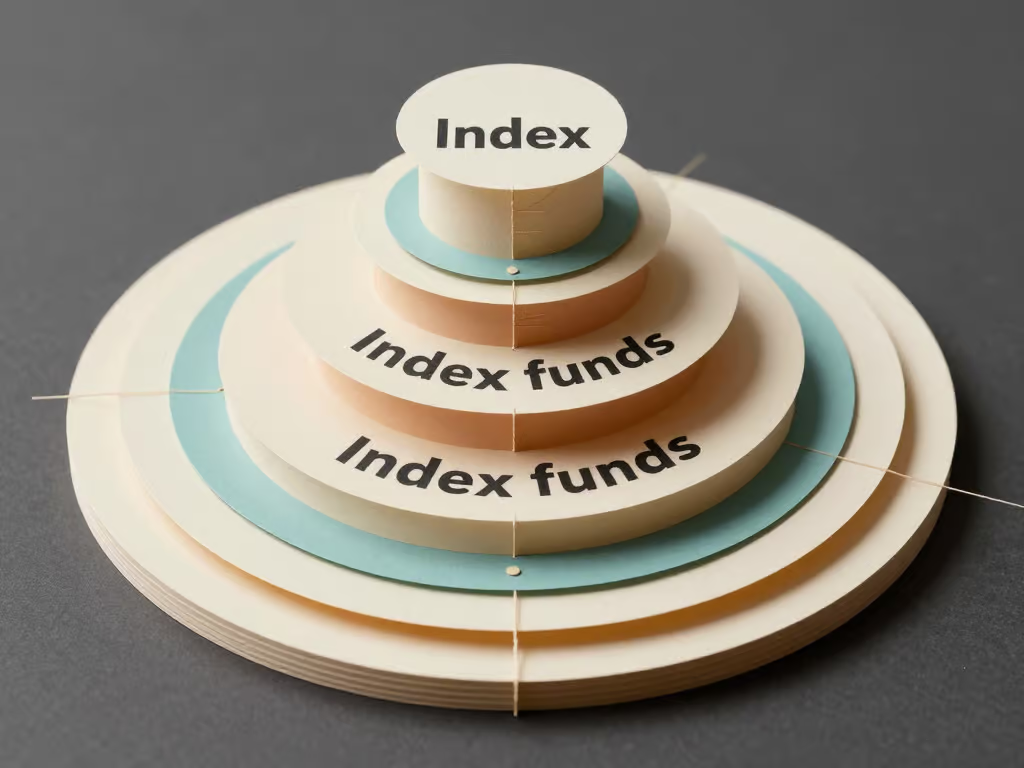
Compounding is reinvesting your earnings so they start earning their own returns. Over time, this creates a growth loop where gains generate more gains. The longer you stay invested, the more you benefit from compounding. For example, earning 6% a year and reinvesting can turn $1,000 into about $1,060 after one year and roughly $1,123 after two years.
Time horizon and growth potential
Starting early unlocks the most potential. A longer time horizon lets you ride more market cycles and smooth downturns. Even small, regular investments can grow substantially when they compound over decades. A practical approach is to set a fixed monthly contribution and avoid pulling funds during dips; the market tends to recover, letting compounding work even in rough periods.
Examples illustrating long-term wealth buildup
- Put aside $200 monthly into a broadly diversified stock portfolio for 30 years. With an assumed 7% annual return, the balance can surpass six figures thanks to both contributions and compounding.
- Starting at age 25 versus 35 creates a big gap in final wealth. If you invest $300 a month from 25 to 65 at 7% growth, you could reach around $1.1 million, while starting at 35 might yield roughly $600,000.
- Reinvesting dividends compounds returns further. If a fund yields 2% in dividends and you reinvest them, you add an extra layer of growth on top of price appreciation.
- Real-world tweak: bite-sized increases. If you raise your monthly contribution by $25 each year after a raise, you accelerate compounding without changing your lifestyle much.
Consistent investing: The habit that builds wealth
Regular contributions and dollar-cost averaging
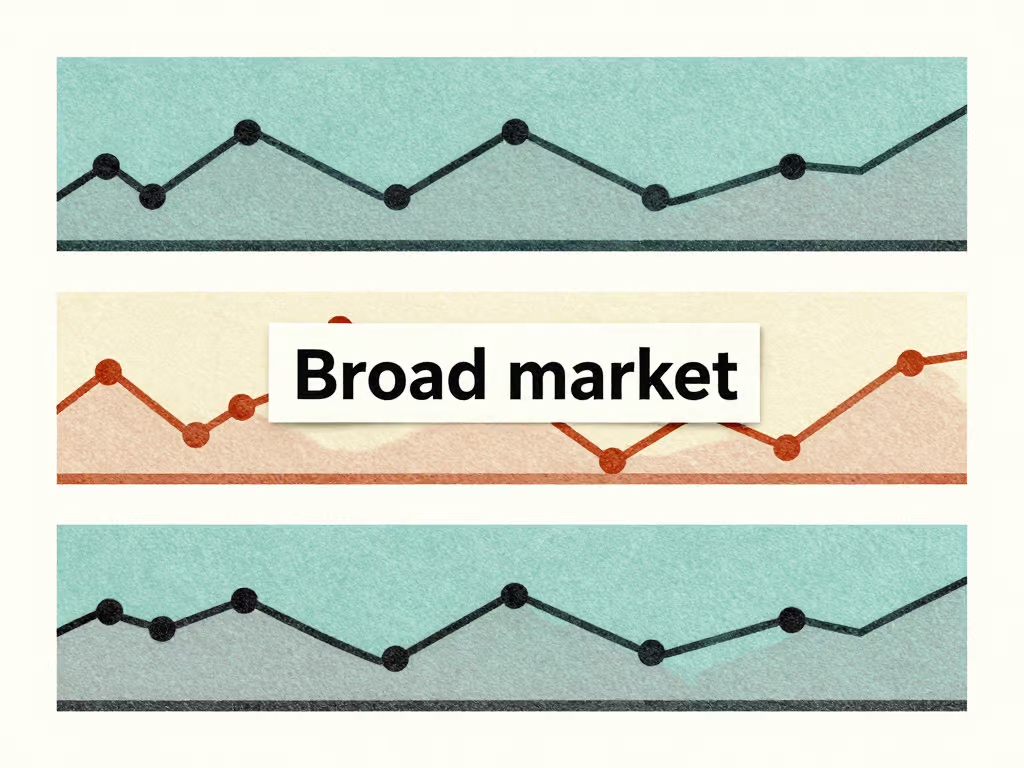
Small, steady deposits beat big, rare bets. Regular contributions let you buy more shares when prices are low and fewer when they are high, smoothing market swings over time. For example, investing $300 every month for 20 years can build a meaningful nest egg even if the market has big ups and downs.
- Set a fixed monthly amount to invest, regardless of market mood. If the market falls 10% in a month, you still invest the same dollar amount to buy more shares at lower prices.
- Increase savings gradually. If you get a raise, bump the automatic contribution by 2, 5% to accelerate growth without changing your day-to-day spending.
- Stay consistent during volatility. In years with market rallies, you’ll still invest regularly, which can smooth returns over a multiyear horizon.
Automation and account setup
- Open an account with a brokerage or retirement plan. Compare fees, available funds, and whether there are account minimums.
- Link payroll or a bank transfer for recurring investments. Set up a biweekly or monthly schedule so the transfers occur without manual intervention.
- Choose a simple vehicle, like broad market index funds, to start. For instance, a total stock market fund can give you diversified exposure with one ticker.
- Set alerts and review quarterly. Ensure deposits are happening as planned and that you’re not triggering avoidable fees or taxes.
The role of disciplined investing in wealth accumulation
Discipline matters as much as returns. Staying invested through ups and downs helps you capture long-term growth, while skipping penalties from trying to time the market. A practical rule is to avoid high-fee funds and to rebalance once a year so your target mix stays aligned with risk tolerance.
| Aspect | Impact on wealth |
|---|---|
| Regular contributions | Builds habit, grows with time |
| Dollar-cost averaging | Reduces timing risk |
| Automation | Maintains consistency, lowers effort |
| Rebalancing | Preserves target risk level, prevents drift |
The role of stocks in a wealth-building plan

Why stocks offer growth potential
Stocks give you ownership in a company and a share of its profits. Over the long run, well-chosen stocks tend to rise as earnings grow, helping your portfolio expand beyond what a savings account can offer. Think of stocks as the part of your plan that captures economic growth over time.
Risk and return trade-offs compared to other assets
Stocks can be more volatile than bonds or cash, with short-term swings. But they also offer higher potential returns over time. In exchange for that extra risk, you may see stronger wealth growth if you stay invested and diversify.
- Growth stocks can push your portfolio up in good economies, but they may fall more in downturns.
- Value stocks can provide steadier performance when priced attractively relative to fundamentals.
- Bonds and cash add ballast, helping reduce overall portfolio risk when combined with stocks.
Diversification as a wealth protection tool
Diversification spreads money across different stocks, sectors, and regions so a poor run in one area doesn’t sink the whole portfolio. A well‑balanced mix can smooth returns over time and reduce the chance of a big loss.
How to start: building a personal investment foundation

Establishing emergency savings
Before you invest, set aside a ready reserve. An emergency fund helps you avoid selling stocks at a loss during a market dip. A practical target is three to six months of essential expenses in a safe place.
- Use a savings account with easy access.
- Automate a small monthly transfer until you reach the goal.
- Keep the fund separate from your investing money to avoid temptation.
Debt management and credit awareness
High-interest debt can erase investment gains. Pay down credit card balances and other costly borrowings first. Knowing your credit health helps you plan smart moves and qualify for better loan terms when needed.
- List all debts by rate, then attack the highest rate first.
- Consider a balance transfer only if fees and terms make sense.
- Maintain a modest credit utilization ratio to protect your score.
Choosing suitable accounts and investment vehicles
Select accounts that fit your goals and taxes. Tax-advantaged accounts can boost growth, while regular brokerage accounts offer flexibility. Start with simple, broad options to build confidence.
| Account type | Best use | Key tradeoff |
|---|---|---|
| 401(k) or IRA | Tax advantages for retirement | Early access penalties |
| Brokerage account | Flexible investing, wide choices | Taxes on gains |
| Target date fund | Set-and-forget retirement path | Hybrid risk profile |
Practical investment strategies for wealth

Index funds and broad market exposure
Index funds provide broad market exposure at minimal cost. They track major benchmarks like the S&P 500, offering steady growth over time without the need for stock picking.
- Low costs help compounding work faster.
- Easy to manage, making them ideal for beginners and busy investors.
- Serve as a reliable baseline for a diversified portfolio.
Asset allocation for different life stages
Your mix of stocks, bonds, and cash should fit your time horizon and risk tolerance. Younger investors can lean toward growth with more stock exposure, while those closer to retirement add stabilizing bonds.
- Young adults: 80% stocks, 20% bonds for growth and learning.
- Mid-career: 60% stocks, 40% bonds to balance risk and reward.
- Near retirement: 40% stocks, 60% bonds to protect capital.
Rebalancing and staying invested through market cycles
Rebalancing helps keep your target mix intact as markets move. It also prompts disciplined buying and selling to maintain risk levels.
- Set a routine, such as quarterly or semiannual checks.
- Use tax-efficient trades when possible to protect after‑tax returns.
- Staying invested through downturns often yields higher long‑term gains.
6. What influences stock returns and wealth growth
Economic growth, earnings, and valuations
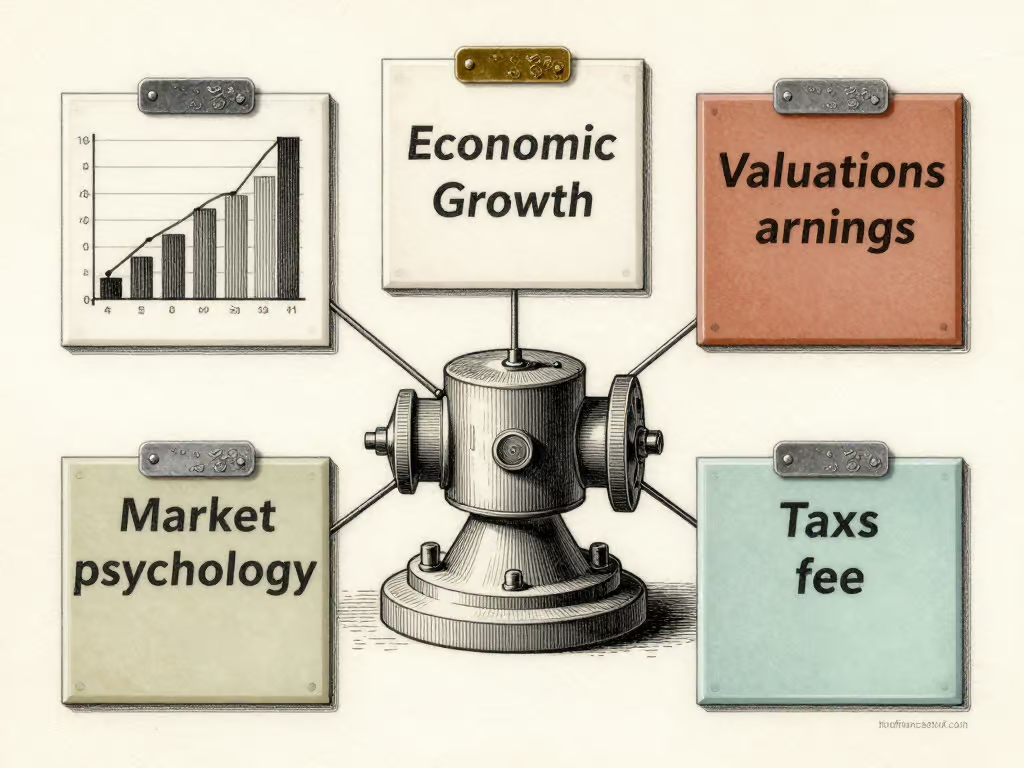
Stock returns rise when the economy expands and companies grow earnings. Strong earnings support higher stock prices, while valuations determine how large gains can be at given earnings. In plain terms, growth and how the market prices that growth matter more than luck.
- GDP trends often align with rising profits and stock prices over time.
- Quarterly and annual earnings reports drive short-term moves and long-term expectations.
- Valuation levels, like price-to-earnings ratios, influence how much growth is priced in today.
Market psychology and volatility
Investor mood and risk appetite can push prices beyond fundamentals. Confidence can spur buying, while fear can trigger selling. This creates volatility that can open chances or raise risk, depending on your time horizon.
- News cycles cause rapid price swings, not just changes in company value.
- Diversified portfolios tend to smooth out spikes from emotions and sector swings.
- Staying invested through cycles often yields better outcomes than trying to time the market.
Taxes and fees: maximizing net returns
What you keep after taxes and costs matters as much as gross gains. Fees and taxes can erode long-term growth if not managed.
- Taxes on capital gains depend on holding period and account type.
- Low-cost funds reduce drag on compounding over decades.
- Tax-efficient strategies, like using tax-advantaged accounts when appropriate, boost net returns.
FAQ
Can investing make you rich quickly?
The short answer is no. Lasting wealth comes from staying invested over many years, not from fast wins. Prices can move fast, but growth over time comes from steady contributions and compounding. For example, $5,000 invested in a broad index fund at age 25 plus $200 monthly can grow substantially by 50 thanks to rounds of reinvested gains and regular saving.
How much should I invest to start building wealth?
Begin with what you can comfortably save after essential expenses. A practical rule is to set up a fixed percentage of income for investing and automate it. If you earn $4,000 monthly, aim for 10, 15% ($400, $600) to form a solid habit. If that feels tight, start with $100 a month and increase 1, 2% of income every six months. Use a simple calculator to project growth with an average 7% return and adjust as your situation changes.
Is it possible to lose money investing in stocks?
Yes. Stocks can go down in the short term. Diversification, a long horizon, and avoiding high-cost bets help protect you. Practical moves include spreading money across 3, 5 broad funds or ETFs, rebalancing annually, and limiting frequent trading. For example, if one fund falls 20% during a dip, you might buy more of another that’s stable or up, keeping risk balanced. The goal is to manage risk while seeking growth, not to eliminate risk entirely.
Conclusion
Recap of key principles
Wealth builds from steady, disciplined actions over time. Start with a solid base, emergency savings, a realistic budget, and a plan to invest regularly. Stocks offer growth potential, but diversification remains essential to manage risk. The magic is in compounding: the earlier you start and the longer you stay invested, the more your money can grow.
Encouragement to start and stay consistent
Small, regular investments can compound into meaningful wealth. The sooner you begin, the more time your money has to grow. For example, automating $200 a month in a low‑cost ETF can build a substantial sum over decades, while delaying starts cuts potential growth. Stay the course through market swings, keep costs low, and resist chasing quick gains. A practical rule is to increase contributions when your paycheck rises or debt payments fall.
Next steps to begin your wealth-building journey
- Open a retirement plan or brokerage account to access broad market funds. For example, a Roth IRA or a standard brokerage with target index funds.
- Set a monthly investment target and automate contributions. Start with 3, 6% of take-home pay and adjust after tax changes or life events.
- Choose low-cost index funds or ETFs to diversify with ease. Look for expense ratios under 0.10% where possible and ensure you own a broad market fund like total market or S&P 500 tracking.
- Review your plan annually and adjust for life changes and goals. Rebalance once a year, account for raises, and incorporate new goals such as education funding or a home purchase.