
Investing for Beginners: A Guide to Stocks & Building Wealth helps you start investing with confidence. You will learn what a stock is, how the market works, and simple ideas to grow your money over time. The guide also explains key terms, how to build a beginner-friendly investment portfolio, and how to keep costs and risks in check.
- Plain language explanations of ideas like diversification, risk tolerance, and long-term investing.
- Step-by-step ideas for starting small, staying consistent, and tracking your progress.
- Practical tips on choosing a beginner’s guide to investing. brokerage, setting up accounts, and avoiding common mistakes.
Read the sections in order if you are new to investing. If you already know the basics, jump to the parts about building a investment portfolio or choosing a brokerage. Use the tips to set up your first investment account and start saving and investing regularly.
- Focus on long-term goals and your risk tolerance.
- Keep an emergency fund in a safe place like a savings account before investing.
- Set a small, regular amount to start investing, then grow it over time.
If you want a quick takeaway: think of investing as putting money to work for you in varied asset classes, with a plan to protect what you save while aiming for steady returns. This guide aims to build your confidence and show you how to build wealth over time.
Stock Market Basics: How Stocks Work and Why They Grow Wealth

What is a stock?
A stock is a small piece of a company. When you own stock, you own a tiny part of that business. The price you pay can go up or down based on how the company performs and how investors feel.
Stocks are bought and sold on exchanges like the NYSE or Nasdaq. You usually use a brokerage account to place trades. The goal is to buy for a good price and sell later at a higher price to earn a return.
Dividends, growth, and price appreciation
There are three main ways stocks can help you grow money:
- Dividends are regular cash payments some companies share with shareholders. For example, a mature company might pay a quarterly dividend of 50 cents per share.
- Growth happens when a company earns more over time, which can support a higher stock value. A fast-growing firm may reinvest profits to expand, boosting future value.
- Price appreciation is when the stock price rises from your purchase price. If you buy at $30 and it moves to $40, you have $10 per share in potential gain.
Many beginners start with funds that own many stocks, so they can benefit from several of these growth ideas at once.
Risks and volatility
Stocks can move up and down a lot in a short time. This is called volatility. The main risks include a company performing poorly, changes in the economy, or shifts in investor mood.
To keep risk manageable, use a broad mix of assets and think long term. Remember, investing involves risk and you may lose money, so plan with a clear risk tolerance and a safety net like an emergency fund.
Practical example: if you rely on a paycheck next year, avoid loading up on high-volatility tech stocks. Instead, build a core with steady dividend payers and broad index funds as part of your guide to investing.
Starting your investment journey
When you begin, consider these steps to build a solid plan:
- Set a goal, like saving for retirement or buying a home.
- Open an investment account and consider a retirement account for tax benefits. Compare fees and account minimums before choosing where to start putting your money to work.
- Keep an emergency fund in a savings account or money market fund before you invest a lot.
- Choose your approach: you can pick individual stocks or use diversified options like mutual funds or ETFs.
How to diversify and grow your investment portfolio
Diversification means spreading money across different asset classes and investments. This helps reduce risk and smooth returns over time.
- Mix stocks with bonds or other fixed income ideas. For example, include a broad bond ETF alongside your stock picks.
- Include mutual funds or ETFs for instant broad exposure. Look for options with low fees and high diversification.
- Keep some funds in a savings account Consider keeping a portion of your savings in stocks or bonds or cash-equivalent for emergencies. A small cash reserve can prevent forced selling.
Long-term thinking and compounding
Compound growth is when your money earns returns, and those returns earn more money. The sooner you start, the more your money can grow over many years.
For example, saving a small amount regularly and earning modest returns can add up a lot over time with compound growth. This is a key idea in investing for beginners and helps you build long-term wealth.
Choosing beginner-friendly options
Good paths for beginners include:
- ETFs or mutual funds that hold many stocks at once, reducing risk.
- Robo-advisors like Betterment or Wealthfront that manage a diversified portfolio for you with low fees.
- Online brokerages like Vanguard, Schwab, or Fidelity that offer easy accounts and educational tools.
Important facts and safety tips
Investing can help grow money, but it also has risks. Do not put money you need right away into stocks. Build an emergency fund first and pay down high-interest debt if you have it. Invest regularly and avoid trying to time the market.
Edge case: during market crashes, staying the course and continuing to invest small amounts can lower your average cost per share over time.
Next steps for you
To start with confidence, outline your goals, set a small monthly plan, and choose a simple path like a diversified investment portfolio. Remember, the earlier you start, the more time your money has to grow.
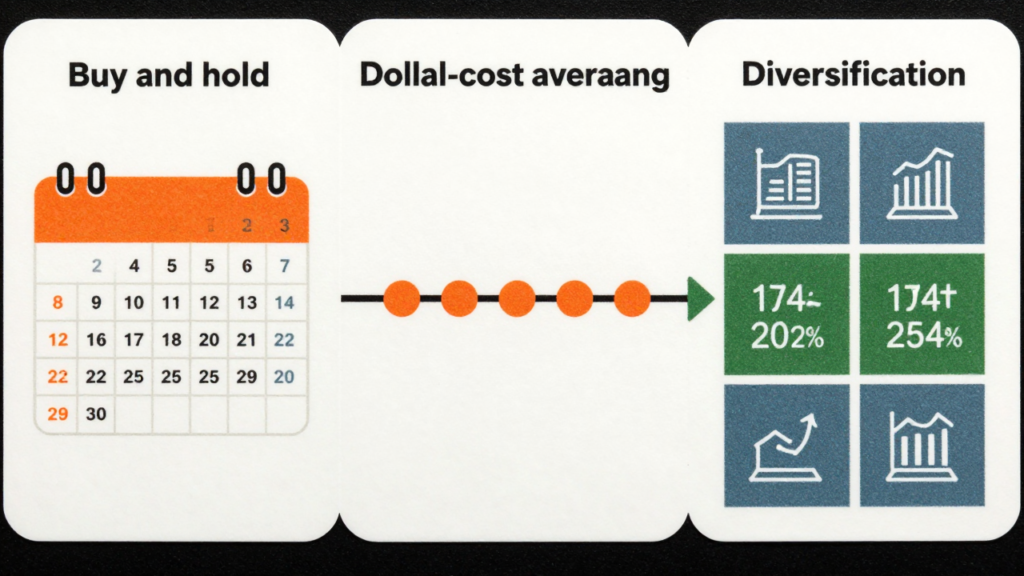
Core Investment Strategies for Beginners: Buy and Hold, Dollar-Cost Averaging, and Diversification

Long-term mindset and compounding
Think long term to grow wealth. This means you hold investments for years or decades. Compound growth happens when your returns earn more money over time. Start with clear goals and a simple plan you can stick to.
Spread your money across different kinds of assets to reduce risk. The aim is steady growth, not quick wins. Past results do not guarantee future results.
Regular investing with fixed contributions
Regular investing means adding a set amount on a regular schedule. This approach is often called dollar-cost averaging, a key concept in your investing strategy. It helps you buy more shares when prices are lower and fewer when prices rise.
- Choose a small, repeatable amount you can save each month.
- Automate transfers from your savings or checking account.
- Keep contributions steady even when markets move up or down, and don’t forget to set money aside.
Spreading risk across assets
Diversification means not putting all money in one place. You spread money across different asset classes and funds to reduce risk. A diversified portfolio aims to balance potential returns with safety while setting money aside.
- Asset classes include stocks, bonds, cash equivalents, and real estate funds.
- Use a mix of individual stocks and funds like mutual funds or exchange-traded funds (ETFs) to cover broad markets.
- Rebalance occasionally to keep your target allocation as markets move.
| Strategy | Why it helps beginners in learning about investing. | Simple tip: learn how to start investing early to maximize your returns. |
|---|---|---|
| Buy and hold | Reduces trading costs and emotions from short-term moves | Set a long horizon and ignore daily noise |
| Dollar-cost averaging | Prevents timing the market and builds discipline | Automate monthly contributions |
| Diversification | Spreads risk across different assets | Use funds to cover broad markets |
Investing for beginners benefits from a steady plan that combines these ideas. Start with a simple mix, then adjust as your goals and risk tolerance change. Soon, you can build a solid investment portfolio that grows with time.
End with a quick step: set a small monthly contribution, pick a broad fund or two, and set up automatic deposits. This puts your plan in motion and starts your journey toward long-term wealth.
Build Your First Portfolio: A Simple, Beginner-Friendly Mix
Choosing between funds and individual stocks
Choosing between funds and individual stocks helps beginners start with less risk while still learning. A fund pools many investors to buy a broad set of assets, which spreads risk and lessens the impact of any single company’s moves.
If you want more control, you can buy individual stocks, but this requires research and a higher risk tolerance. A common approach is to use a mix: funds for the core, and a few selected stocks as small bets.
Starting with a diversified investment fund lets you gain broad exposure without researching every company. You can then add a small number of shares in familiar companies to learn by doing.
Example starter allocations
- Core fund or ETF that tracks a broad market index to cover many companies
- Bond or cash-like fund to provide ballast and reduce volatility
- A small amount in a targeted sector or theme you understand for growth potential
| Asset | Purpose | Typical share for beginners |
|---|---|---|
| Broad market fund | Core growth and diversification | 60%-70% of your contributions should be allocated to benefits of investing. |
| Bond or cash fund | Stability and income | 20%-30% |
| Individual stock or small fund | Potential extra return | 5%-15% |
Rebalancing basics
Rebalancing helps keep your plan aligned with goals. Markets move, so your mix can drift over time.
- Check target allocations at regular intervals, like twice a year
- Sell assets that have grown too large and buy those that lag to restore balance
- Avoid chasing short-term moves; keep a long-term view
Rebalancing helps maintain your portfolio’s alignment with your long-term investing strategy. risk tolerance and your path to build wealth over time.
Practical tips for beginners
- Open an investment account and a separate savings account for emergencies before investing. An emergency fund helps you avoid selling at a bad time, especially if you’re investing in volatile markets.
- Choose a brokerage with low fees and learning tools. Many platforms offer beginner friendly automated investing options.
- Keep costs low. Look for low expense ratios and avoid high-fee accounts that erode rate of return over time.
Where this fits in your plan
This plan sits at the core of your investment portfolio. It balances growth with safety and gives you space to learn about asset classes and diversification.
Common questions for beginners
- Is it better to invest Are you considering investing through funds or individual stocks and bonds? For many beginners, funds are easier and safer to start with.
- How much should I start with? Begin with small amounts and add over time through investing regularly.
- What is diversification? Spreading money across different assets to reduce risk and smooth returns.
Remember, the goal is a steady path to putting your money to work. long-term wealth with simple steps, clear goals, and consistent practice. If you follow these basics, you can start putting your money to work. start investing with confidence and watch your money grow over time.
End with a short plan: set a goal, pick a core broad market fund, add a bond or cash fund, and consider a small amount in a sector you understand. Check allocations twice a year and rebalance if needed. This is how you begin your journey toward a safe and growing investment portfolio.
Tax-Smart and Low-Cost Investing: Fees, Taxes, and Accounts to Consider

Understanding fees and expense ratios
Fees affect how quickly your money grows. Look for low-cost options that fit your plan. Expense costs add up over time, so even small differences matter. For example, a fund charging 0.50% per year can shave off more of your returns over many years than one charging 0.05%.
Expense ratios show how much a fund charges each year as a percentage of assets. A smaller number means more of your money stays invested, maximizing the benefits of investing. This helps your portfolio grow over the long term. If you start with a $10,000 balance and the annual return is 6% before fees, a 0.50% expense ratio reduces your end result by about $300 after 10 years compared with a 0.05% ratio.
- Compare the annual expense ratio of funds before buying.
- Watch trading fees and commissions from your chosen broker.
- Consider total costs, not just the sticker price.
Tax-advantaged accounts overview
Tax-friendly accounts can help your money grow faster. Different accounts offer different tax benefits and rules, so consider them when starting to invest. This matters for your long-term plan. The right mix can lower your tax bill and boost compounding.
- Retirement accounts let you defer taxes until you withdraw, helping compounding.
- Savings and investment accounts may have no special tax treatment but offer liquidity while putting your money to work.
- Some accounts require minimum deposits or have withdrawal restrictions.
| Account Type | Tax Benefit is an important aspect of investing for retirement. | When to Use |
|---|---|---|
| Retirement account | Tax-deferred growth or tax-free withdrawals in some cases can be part of your investing strategy. | Long-term planning for future income |
| Savings account | Normal tax treatment; high accessibility | Emergency fund and short-term needs |
| Investment account | Taxes on gains and dividends in year of realization | General investing with flexible access |
Minimizing tax drag
Tax drag is the gap between pretax gains and after-tax returns. Small moves here add up over time. For example, placing more growth assets in tax-advantaged accounts can reduce annual tax drag by several percentage points over a decade.
- Use tax-efficient funds in taxable accounts, such as broad market ETFs or index funds with low turnover.
- Hold investments for the long term to benefit from lower long-term capital gains rates.
- Avoid frequent trading that generates short-term capital gains.
Invest with awareness of costs and taxes to help your money grow more efficiently and reach your goals sooner.
Tools and Resources for Beginners: Platforms, Research, and Learning

Choosing a brokerage
Choose a brokerage that is friendly to beginners. Look for low fees, a straightforward app, and clear guidance. You want an investment account you can open easily to start building your portfolio.
- Low or zero trading commissions can save you money as you learn.
- Educational content helps you understand investing basics and the right investment strategy.
- Good customer support matters when you have questions about orders or deposits related to your investing strategy.
Beginner-friendly research tools
Use simple tools to learn about self-directed investing. stocks and other assets like stocks and bonds. Focus on clear numbers and plain explanations.
- Company profile pages show what the business does, revenue, and risk factors.
- Stock screeners help you filter by price, dividend yield, and growth potential.
- News summaries and earnings calendars help you stay informed without noise.
Keep your search focused on long-term growth ideas and steady income possibilities rather than quick wins.
Educational resources and practice
Learning early builds confidence in your ability to navigate the guide to investing. Use practice environments to test ideas without risking real money.
- Guides and tutorials explain types of investment and how to build an investment portfolio.
- Simulated trading or practice accounts let you place mock trades and see how your ideas perform over time, aiding in learning about investing.
- Books and short courses can reinforce the basics of asset allocation and diversification.
Pair learning with small, regular real-world steps like setting up an emergency fund and choosing a simple starter savings account for cash reserves.
FAQ
How much do I need to start?
You can start with a small amount. Many people begin with hundreds of dollars and add more over time. Look for accounts that allow you to buy fractions of a share or to contribute small, regular amounts. This helps you start investing with confidence and build your investment portfolio gradually.
How should a beginner invest in stocks?
Begin with a simple plan. Focus on steady, long-term growth and avoid high-risk bets when you’re investing for retirement. A diversified approach helps reduce risk.
- Open a basic savings account To build an emergency fund first, you need a lot of money saved up.
- Choose an investment account or a retirement account for tax benefits.
- Use broad options like stocks or exchange-traded funds (ETFs) to spread risk.
What is the 3 5 7 rule of investing?
The 3, 5, 7 rule is a simple planning idea. It suggests setting goals for different timeframes and aligning your risk tolerance with those goals. Short term goals may use more stable assets, while long term goals can ride market cycles.
How to turn a small amount into meaningful wealth?
Start with consistency and patience. Small, regular contributions grow over time through compounding. Use a diversified investment mix and avoid trying to time the market. Remember that investing involves risk and results can vary.
Remember, investing involves risk, and returns can vary. Start with the basics, build an emergency fund, and grow your knowledge as you grow your portfolio.
Conclusion
Key takeaways
Investing is a practical way to grow money over time. A simple plan helps you stay on track and reduces risk. Start with a solid emergency fund and use a basic investment account to build your portfolio.
- Early planning matters. The sooner you start investing, the more time your money has to grow through compound growth.
- Diversification protects you against the risks of past performance not indicating future results. Spread money across different asset classes to reduce risk and smooth returns.
- Stay focused on long-term goals. Let compounding work for you by staying invested and avoiding frequent tuning of plans.
Next steps for new investors
Take small, regular steps to build confidence and experience. Use simple, low-cost options to begin self-directed investing and learn as you go.
- Open a basic brokerage account and consider a retirement account for tax benefits.
- Choose a diversified mix, such as broad market funds, to start your investment portfolio.
- Set a regular contribution schedule to practice dollar-cost averaging and habit formation.
Remember, investing for beginners is about steady progress, not perfection. Start investing with confidence, build wealth over time, and plan for a secure financial future.