
Your bank account likely looks different than it did just a few years ago because types of money is changing faster than ever. Mobile payments handled over 50% of all online shopping around the globe. This shift means that the way you use currency (money used by a country) is moving from physical paper cash to electronic records in a computer. Understanding the different types of money helps you see how your own economic power grows or shrinks depending on where you keep your wealth.
Money is anything that people agree to use as a medium of exchange (a way to trade for things). Long ago, people used barter (trading one item for another), but that was hard because you had to find someone who wanted exactly what you had. Today, our financial system uses fiat money, which is paper money that has value because the government says so. It is not backed by a physical commodity (a raw material like gold) anymore, but it works because of public confidence and the stability of government bodies like the Federal Reserve.
“Inflation is always and everywhere a monetary phenomenon.”- Milton Friedman, Economist
You will find that money serves as a store of value (a way to save for later) and a unit of account (a way to measure how much things cost). As 130 countries explore digital currencies issued by central banks, the way you buy and sell goods and services will continue to change. This guide explains the four types of money you need to know and how supply and demand (how much is available versus how much people want) affect your daily life. You will learn about:
- The history of commodity money like gold and silver.
- How commercial bank money represents your customer deposits.
- The rise of cryptocurrency and its disruption of old money systems.
- Why the US dollar and British pound stay strong in the global financial market.
By learning these basics, you can navigate the risks involved in modern economies. Whether you use a check, a debit card, or a digital app, knowing how money works helps you protect your financial future. 😊
What Money Really Is and Why We Need It
You might think of money as just the green paper in your wallet or the numbers on your banking app, but it is actually a clever solution to a very old problem. Before money existed, people used a barter system, which meant trading one thing directly for another, like swapping a bag of apples for a pair of shoes, is an early example of the properties of money. This was incredibly difficult because of the double coincidence of wants; you had to find someone who not only had what you needed but also wanted exactly what you were offering at that very moment.
The inefficiency of bartering often brought trade to a halt. If you were a fisherman who needed a new roof, but the builder didn’t like fish, you were stuck. The invention of money fixed this by providing a universal “middleman” that everyone agrees to accept. This shift allowed modern economies to grow because you could sell your goods to anyone, collect money, and then use that money to buy what you actually needed from someone else entirely.
The Four Critical Jobs of Money
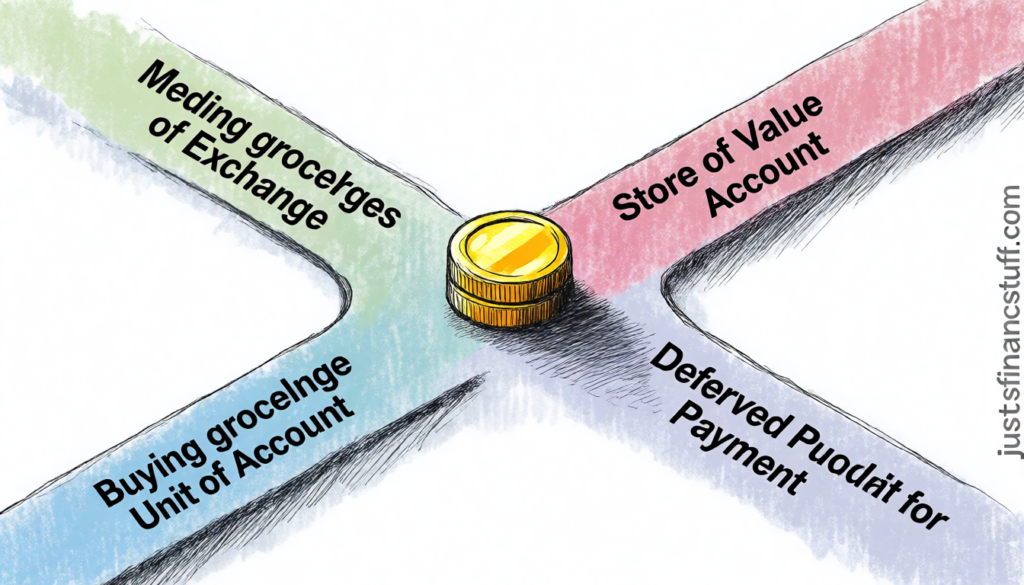
To keep the global financial system moving, money must perform four specific roles. If an object fails at even one of these, it usually stops being used as a currency. Banks and You rely on these functions every time you check a price tag or save for a vacation.
- Medium of Exchange: This is the primary form of money use. It is something you give to a seller to get goods and services, like using a US dollar to buy lunch.
- Unit of Account: Money acts as a yardstick. It provides a common way to measure the value of different items, so you know that a car is worth more than a toaster without having to compare them in “apple” units.
- Store of Value: a critical property of money that ensures it retains worth over time. You can hold onto money and spend it later. Unlike a crate of strawberries that rots, money is meant to keep its intrinsic value over time so you can use it in the future.
- Standard of Deferred Payment: This allows you to buy something now and pay for it later. It is the basis for loans and types of money checks, ensuring debts can be settled in a predictable way.
“Money is not a thing, but a system of credit and clearing. It represents a claim on the energy and tools of others within a society.”- Financial Research Perspective
Trust is the glue that holds these money systems together. Whether you are using commodity money (like gold and silver) or modern fiat money (which has no commodity backing), the system only works if you believe you can trade that money for something else tomorrow. Today, central banks and the Federal Reserve work to maintain this economic stability by managing the money supplies can include various forms such as cowrie shells and fiat currencies.. This foundation of trust is what allows daily transactions to happen instantly, moving us further away from the cashless hurdles of the ancient past and toward a more efficient monetary system.
From Gold Coins to Paper Cash Your Money’s Journey
Money has evolved from heavy metal to light paper. While you already know that money makes buying and selling easier than swapping chickens for shoes, the physical form of your cash has changed drastically over time. In modern economies, we have moved away from things that have value on their own toward systems built entirely on public confidence and government backing.
The Era of Commodity Money
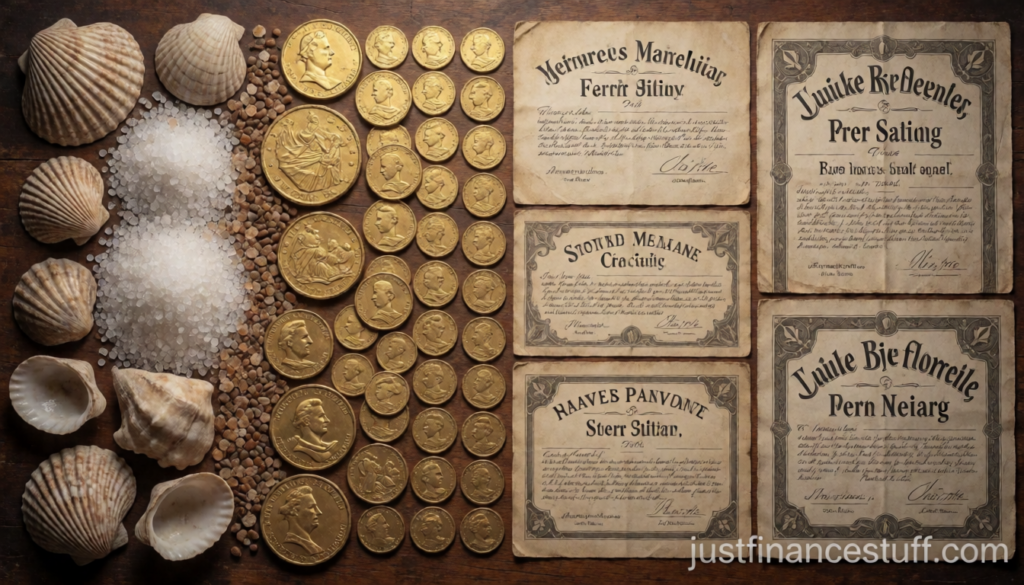
The earliest types of money were often actual goods. This is known as commodity money, where the item used as cash has intrinsic value (value in and of itself). For thousands of years, people used gold and silver because these precious metals were rare, durable, and easy to recognize across different cultures.
Gold and silver coins were the ultimate standard of deferred payment because everyone agreed they were valuable. However, carrying heavy bags of metal was risky and exchangeable goods were hard to move in large amounts. This inefficiency led to the invention of money substitutes, like paper receipts that represented the metal sitting safely in a vault.
- Commodity: Items like salt, shells, or precious metals.
- Representative Money: Paper money that you could trade in for a specific amount of gold.
- Commodity Backing: A system where a deposit of metal backed by a physical commodity gave paper its worth.
The Rise of Fiat Currencies
Today, most global currencies are no longer tied to gold. We use fiat money, which is currency that has value because a government says it does. Fiat currencies like the Japanese yen or the British pound do not have intrinsic value; you cannot melt a five-pound note down to make jewelry, but you can use it as legal tender to pay your taxes.
“The shift to fiat money allows central banks to use monetary policies to manage economic stability, rather than being limited by how much gold is in the ground.”- Financial Research Archive
87% of the world’s wealth exists in some form of fiat system. This transition happened because modern economies need a flexible monetary system that can grow as supply and demand for goods and services change. Even though it isn’t backed by gold, fiat money systems work because of the stability and economic strength of the government bodies that issue them.
Comparing Types of Money
| Type | Source of Value | Examples |
|---|---|---|
| Commodity Money | The material itself | Gold coins, silver bars |
| Fiduciary Money | Trust in the bank | Types of money checks, bank notes |
| Fiat Money | Government decree | US Dollar, Euro |
In daily transactions, you likely use a mix of these. While physical cashless trends are growing, paper money is still a massive part of the global financial landscape. In fact, Euro banknotes in circulation reached €1.6 trillion in March 2023, proving that many people still prefer a physical form for their definitions and examples store of value. Understanding these traditional money systems is a vital step before you look at the disruption caused by digital currencies and cryptocurrency.
Your Bank Account and Beyond: Digital Money Explained

Commercial bank money represents the vast majority of what you spend today, appearing as simple electronic records rather than physical stacks of cash. When you check your balance on a banking app, you are looking at fiduciary money, which is a promise from your bank to pay you on demand. Unlike the coins of the past, this system relies on fractional reserve banking, where banks keep only a small portion of deposits as cash and lend out the rest to keep the economy moving.
The scale of this digital shift is staggering and changes how we define the global financial landscape. In mainland China, the platform Alipay processed over $17 trillion in transactions in 2020 alone, proving that payment systems no longer need physical currency to function at a massive scale. This digital form of money is part of the M1 money supply, which tracks the most liquid assets you can use for daily transactions and buying and selling essentials.
“The move toward digital currencies is not just a change in technology; it is a fundamental shift in how modern economies manage economic stability and public trust.”- Financial Policy Review, 2024
87% of the world’s wealth exists in some form of fiat system. While you might still use a us dollar bill for a small coffee, the peg to commodity backing affects how much we spend. international monetary trend is moving toward cashless solutions. This has led to the disruption of traditional banking through several new digital currencies and money systems:
- Central Bank Digital Currencies (CBDCs): Currently, 130 countries are exploring these, with 68 nations in advanced stages as of May 2024. These are fiat currencies in digital form, backed directly by government bodies.
- Cryptocurrency: Assets like Bitcoin, which saw its market capitalization exceed $1 trillion in early 2024, operate on decentralized networks without central banks.
- Stablecoins: These are global currencies designed to stay steady, with a market cap over $150 billion in early 2024, often exchangeable for a specific fiat money value.
Understanding these different types of money helps you see how the financial system stays flexible. While precious metals like gold and silver once provided commodity backing, today’s value is driven by supply and demand and monetary policies. Even without a physical form, the electronic records in your deposit account serve as a store of value and a standard of deferred payment for your future bills.
The way we move this digital wealth depends heavily on the definitions and examples of money in modern finance. stability and economic strength of the issuing nation. As you navigate these payment systems, you might find yourself wondering why you feel the need to hold onto these balances at all, especially when the economy shifts.
Why You Want Money: The Three Big Reasons
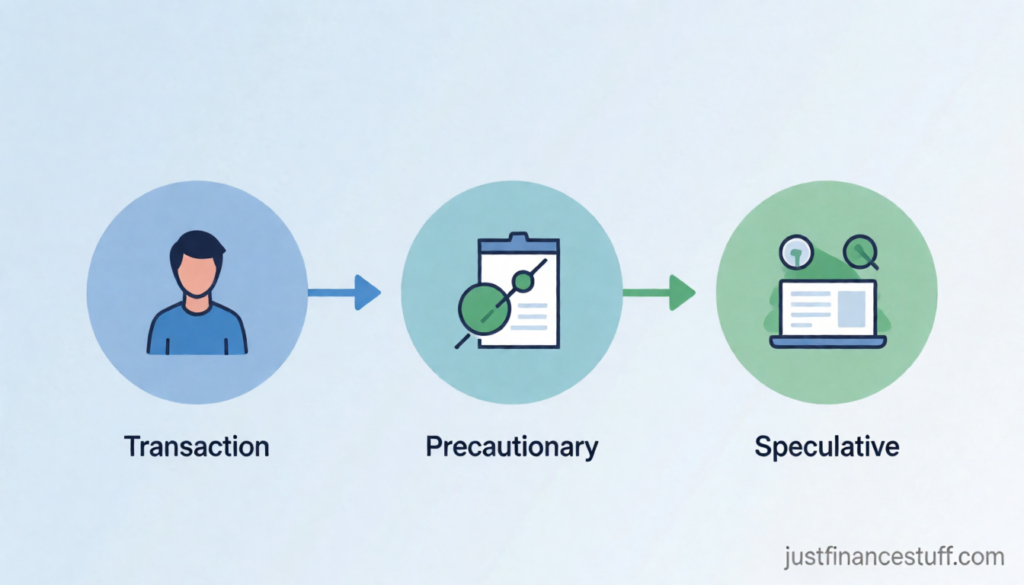
You might think your desire for cash is just about wanting “stuff,” but economists see a deeper pattern in your behavior. While you now understand that your bank balance consists of electronic records, the reason you keep those records active falls into three specific categories. John Maynard Keynes, a famous economist, called this liquidity preference (the desire to hold cash instead of investing it). He argued that your demand for money isn’t random; it is a calculated choice to stay “liquid” so you can act quickly in a fast-moving financial system.
The first reason you want money is for transaction demand. This is the most basic need: having enough currency to pay for your daily transactions. Whether you are buying and selling groceries or paying your monthly rent, you need a medium of exchange that is immediately exchangeable.
Because your bills don’t always align perfectly with your payday, you keep a deposit in your account to bridge that gap. Without this, you would face the inefficiency of having to sell your belongings every time you wanted a cup of coffee.
The second reason is precautionary demand, which is your “just in case” fund. You hold extra money to protect yourself against risks involved in daily life, such as a sudden car repair or a medical bill. This motive provides economic stability for your household.
Businesses do the same thing; they keep customer deposits and cash reserves ready so that a sudden drop in sales doesn’t lead to a total disruption of their operations. This demand often rises when people lose public confidence in the broader economy.
Finally, there is speculative demand, where you hold money to wait for better future opportunities. If you think the price of stocks or houses will drop soon, you might keep your wealth in cash today so you can buy them cheaper later. In this role, money acts as a store of value.
However, holding too much cash can be risky because of inflation. For example, the Euro area annual inflation rate was 2.4% in March 2024.
If your money just sits there, it loses purchasing power because the price level of goods and services goes up.
Summary of Why We Demand Money
| Type of Demand | Main Goal | Real-World Example |
|---|---|---|
| Transaction | Daily spending | Buying lunch with a debit card |
| Precautionary | Safety net | Savings for an emergency car repair |
| Speculative | Investment timing | Waiting for a stock market dip to buy |
“Inflation is always and everywhere a monetary phenomenon.”- Milton Friedman, Economist
Friedman’s Quantity Theory of Money suggests that when central banks like the Federal Reserve increase money supplies too fast, the value of each dollar drops. This relationship between supply and demand is what determines the economic power of your wallet. Understanding these three motives helps you see why the monetary system isn’t just about printing paper money; it is about balancing how much cash you need to feel secure versus how much you need to grow your wealth in modern economies.
How Central Banks Control Your Cash and the Economy

When you notice the price of a gallon of milk or a new car shifting, you are seeing the direct result of monetary policies (rules for managing money) set by government bodies. Central banks, such as the Federal Reserve in the United States or the European Central Bank (ECB), act as the brain of the financial system. Their primary job is to balance the supply and demand of money to ensure economic stability, preventing the economy from growing too fast or crashing into a deep slump.
These institutions use specific tools to move the levers of the monetary system. The most common tool is the adjustment of interest rates, which dictates how expensive it is for you to borrow money for a house or a business. For example, the European Central Bank raised key interest rates by 25 basis points in June 2024. This move was a deliberate attempt to combat inflation by making it more expensive to spend, thereby slowing down the global financial engine to a sustainable pace.
The Tools of the Trade
Central banks do more than just move interest rates; they also engage in defining money through their policies and actions. open market operations. This involves buying and selling government bonds to change the amount of currency available in the modern economies they oversee. When a bank buys bonds, it pumps cash into the payment systems, increasing the money supplies and making it easier for banks to lend to you.
- Interest Rate Adjustments: Higher rates discourage spending to lower inflation; lower rates encourage borrowing to boost growth.
- Quantitative Easing: A method discussed by former Federal Reserve Chair Ben Bernanke, where the bank buys long-term assets to lower interest rates and increase the form of money available.
- Reserve Requirements: Changing the amount of customer deposits a bank must keep in its vault, which limits or expands how much they can lend.
Impact on Global Currencies
The policy decisions made by these banks don’t just affect your local bank account; they shift the value of global currencies like the US Dollar, the British Pound, or the Japanese Yen. If the Federal Reserve raises rates while the Bank of Japan keeps them low, investors often flock to the dollar, changing its economic power on the forex (foreign exchange) market. This affects the price of everything we import and export.
| Central Bank Action | Impact on Your Wallet | Economic Goal |
|---|---|---|
| Raising Interest Rates | Higher mortgage and credit card costs | Lowering inflation |
| Lowering Interest Rates | Cheaper loans for goods and services | Encouraging growth |
| Printing/Creating Money is a fundamental aspect of understanding the 4 types of money in circulation today. | Potential risks involved with rising prices | Increasing liquidity |
“The use of unconventional monetary policies can be a powerful tool when traditional methods reach their limits.”- Inspired by Ben Bernanke, Former Federal Reserve Chair
Ultimately, the public confidence in these definitions and examples of monetary systems, we can see how various forms of money function. fiat money systems is what gives your paper money value. Without a commodity backing like gold, the legal tender you use every day relies on the stability and economic strength of the government. If a central bank increases the supply of money too quickly without a rise in trade goods and services, the value of each dollar drops, proving that the properties of money are crucial in understanding economic fluctuations. macroeconomic balance is a delicate act.

Conclusion
Money works because you trust it to stay valuable. It has changed from heavy gold coins to numbers on a screen, but its job is still the same. You use it to trade your hard work for the things you need to live.
Today, 130 countries are looking into new digital currencies to keep this system moving fast. Your understanding of how these systems work helps you make better choices with every dollar you spend or save.
Key Takeaways for Your Wallet
- Different money types: You use fiat money, which is cash backed by the government rather than gold. Most of your money is actually commercial bank money, which exists as electronic records in your bank account.
- Rising digital use: Mobile payments now handle over 50% of all online shopping around the world. You are part of a global shift toward a cashless society where speed and safety are top priorities.
- Central bank power: The Federal Reserve and other government bodies change interest rates to control the money supply. These policy decisions directly impact how much you pay for a car loan or a house, illustrating the role of intermediaries in the financial system.
- The role of cash: Physical paper money is still important for daily transactions in many places. There is currently €1.6 trillion in euro banknotes being used, proving that cash and digital systems can live together.
Practical Next Steps
Check your bank’s mobile app today to see if they offer instant payment tools. Setting these up helps you move money faster without waiting days for a check to clear. You should also look at your monthly savings to see if your bank raised your interest rate. If the central bank raised rates recently, you deserve to earn more on the money you keep in your deposit account.