

What is the monetary base and why it matters
The monetary base, also known as base money or high powered money, is the foundation of the money system. It comprises currency in circulation and the reserves banks hold at the central bank. These two pieces are the raw money that can expand through the banking system.
Why it matters: changes in the monetary base enable banks to create more or less money. This is a central part of monetary policy. Central banks use the base to influence the overall money stock and, in turn, price levels and inflation.
Overview of the money supply framework
The money supply measures the total amount of money available in the economy. It depends on how the monetary base interacts with banks and the rest of the economy. The framework links:
- currency in circulation
- bank reserves
- the money multiplier that converts base money into deposits
- broader aggregates like M1 and M2 that include deposits and other near money
In short, the monetary base is the starting point. The money supply grows or falls as banks lend and households and firms hold deposits. Central bank actions, such as open market operations, can move the base and, through the multiplier, push the money stock higher or lower.
Definitions and Components

Monetary base components: currency in circulation and bank reserves
The monetary base is the portion of money that a central bank can directly influence. It has two main parts, and understanding how they work helps explain how central banks steer the economy.
- Currency in circulation includes coins and paper money that the public and businesses use for everyday transactions. This is money that leaves the central bank when it is issued and enters the hands of people outside the banking system.
- Reserves consist of two pieces: deposits that banks hold at the central bank and cash banks keep in their vaults. These reserves are the backing for the payments system and for broad deposit liabilities, helping banks settle checks and transfers securely.
Together, currency in circulation and reserves form the base money the central bank can directly change. Because this base is what the banking system uses to create more money through lending, it is sometimes called base money or high powered money. A small shift in the base can lead to bigger changes in the total money stock if banks respond by expanding or tightening their lending and deposit-taking behavior.
Distinguishing monetary base from broader money measures
It helps to separate the base from broader money concepts. The base is a narrow, controllable quantity, while measures like M1 and M2 include deposits and other liquid assets held by households and banks that can be used for spending or saving.
- Money base vs M1: M1 adds checkable deposits to the base, capturing money that can be accessed quickly for spending.
- Money base vs M2M2 extends further by including time deposits and certain money market instruments that are not immediately liquid, contributing to the increase in the money supply.
Central banks influence the base directly through operations such as asset purchases or sales, which can affect the monetary base. The total money stock in the economy, however, also depends on how aggressively banks lend and how people choose to hold their deposits. A higher base can push up lending if banks have demand for loans and adequate capital, while a weaker base can slow lending and constrain growth.
The Money Supply Formula and the Multiplier Concept

The money supply depends on base money and how banks use it. Base money is multiplied through the banking system to create deposits that people and firms hold. This relationship is captured by a straightforward formula and the idea of a multiplier.
The basic relationship between monetary base and deposits
The monetary base sets the floor for money creation through lending. When banks extend credit, the new deposits can fund additional loans. More deposits per unit of base money means a larger overall money stock, which can create money and affect the monetary base.
- The monetary base includes currency in circulation plus bank reserves at the central bank.
- Deposits are the key component that expands the money stock beyond the base, creating money in the process.
- Open market operations and other policy moves can change both the base and the amount of deposits created.
How the money multiplier amplifies the base
The multiplier explains how base money supports a larger total in deposits. It is a ratio: a small change in reserves can lead to a bigger change in money through fractional reserve lending.
- The inverse of the reserve requirement is a common way to express the multiplier.
- Higher reserve requirements dampen the multiplier, while lower ones raise it.
- Actual multipliers vary with borrowers’ demand for credit and the public’s choice between currency and deposits, impacting the required reserve ratio.
In practice, the multiplier links the central bank’s actions to the broader money supply. Changes in the base, via policy tools, ripple through the banking system to influence money in circulation.
Deriving the Monetary Base
How currency in circulation is created and held
The currency in circulation part of the monetary base comes from two sources. First, the central bank prints or mints currency and releases it into the economy through banks and dealers. Second, the public and firms hold that currency for day to day transactions. Once currency leaves the central bank, it moves through the banking system or sits in households and businesses.
Public demand for cash, along with coin and note production, sets the level of currency in circulation. Banks may also receive currency from customers as deposits or withdrawals, including federal reserve notes, affecting how much currency is physically in people’s hands. The total currency in circulation is a key input for measuring base money and helps determine how easily transactions can be conducted.
How reserves at the central bank are accumulated
Reserves accumulate when banks hold deposits at the central bank or keep vault cash. These reserves support the payment system and enable banks to settle trades with each other. Banks build reserves by receiving deposits, by earning interest on holdings, and through central bank operations.
Open market operations and other central bank actions can add or drain reserves. When the central bank purchases securities, reserves rise; when it sells, reserves fall. The level of reserves influences liquidity in the banking system and sets the stage for how much lending can occur, which in turn affects the broader money stock.
Relation to Money Supply Measures
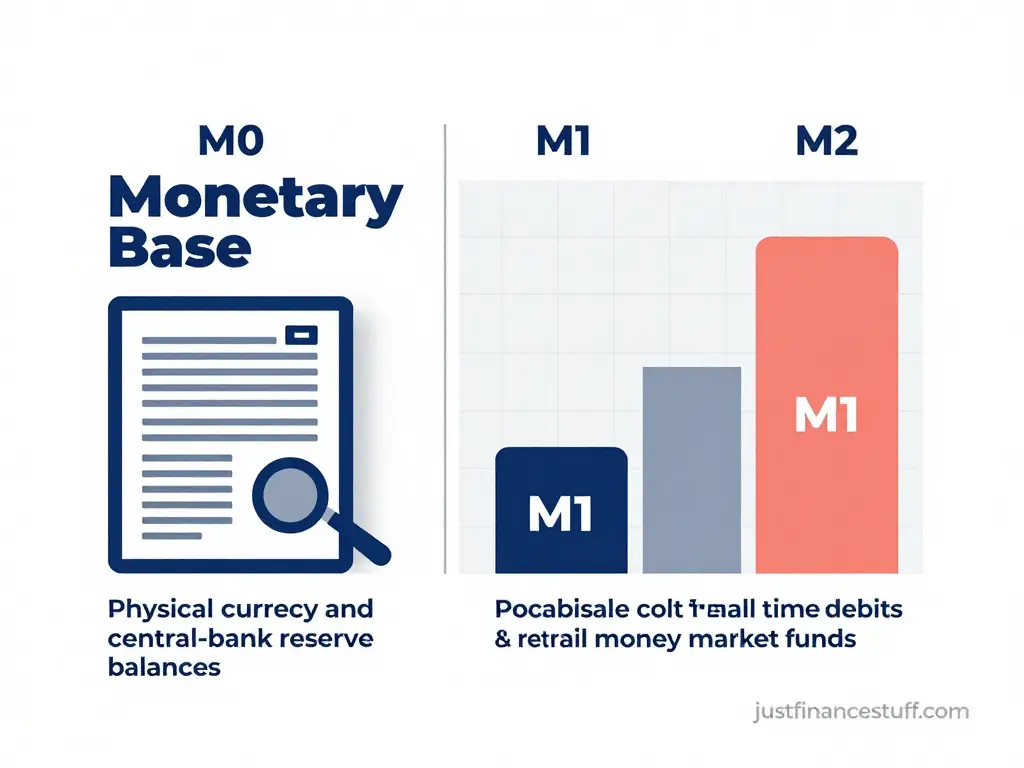
Linking base to M0, M1, and M2 concepts
The monetary base acts as a floor for the total money in the economy, but it is not the same as broader money measures. M0, often called base money, roughly equals the monetary base and includes currency in circulation plus reserves held by banks at the central bank. M1 and M2 expand on this by adding forms of money people use for spending or saving.
- M0 aligns with the monetary base in many definitions, emphasizing currency in circulation and central bank reserves.
- M1 adds checkable deposits held by the public, increasing the stock beyond base money.
- M2 includes time deposits and certain near money, further broadening the total money stock.
The base sets the potential for expansion, but the actual size of M1 and M2 depends on how banks lend, how much people hold as currency, and how depositors use funds. Open market operations can shift the base, and those shifts propagate through the banking system to influence broader money measures over time.
Why the base does not equal broader money aggregates
The base is a narrower concept focused on currency in circulation and bank reserves. Broader money aggregates include deposits and other liquid assets that households and firms can spend or move quickly. This difference matters because:
- Deposits generated from base money require banking activity, borrower demand, and adherence to the required reserve ratio.
- Reserve levels influence, but do not determine, the total deposits people hold.
- Monetary policy can change the base directly, yet the response in M1 or M2 depends on behavior in the economy and the required reserve ratio.
Practical calculation scenarios
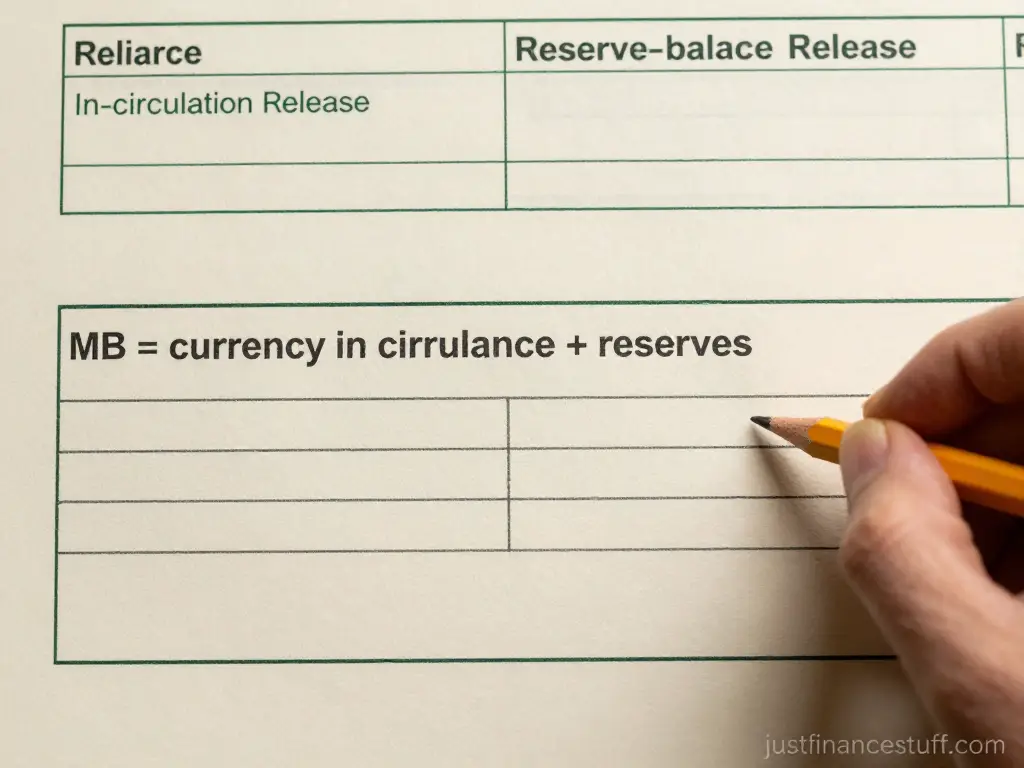
Calculating MB from currency in circulation and reserves
The monetary base (MB) can be calculated by adding two components: currency in circulation and bank reserves held at the central bank. In simple terms, MB = currency in circulation + reserves. This gives the total amount of money that is either in the hands of the public or available to banks to back their balance sheets, including required reserves. When you measure currency in circulation, include notes and coins held by the public and non-bank sectors. When you measure reserves, include both vault cash and reserve balances held at the central bank.
Example approach you can apply in practice:
- Step 1: Measure currency in circulation for the period you’re studying.
- Step 2: Measure total reserves held by depository institutions at the central bank.
- Step 3: Add the two numbers to get the monetary base.
Interpreting changes in MB and potential effects on deposits
When MB rises, banks typically have more reserve backing to support lending. That can lead to higher deposits later, as new loans create further deposits through the banking process. Conversely, a drop in MB can tighten liquidity and slow the growth of deposits.
- Auction or open market operations that increase reserves often expand the base and, with enough loan demand, can raise the money stock.
- Movements in currency held by the public can offset or amplify reserve changes, shaping the final effect on deposits.
- Expected changes in MB can influence lender behavior, borrowing costs, and the pace at which deposits grow or shrink.
Policy implications and real world applications

Open market operations and base adjustments
Open market operations remain the main tool for shifting the monetary base and influencing the required reserve ratio. By buying or selling government securities, the central bank changes bank reserves, which can influence broad money through the banking system’s response.
When the central bank purchases securities, reserves rise and the base expands. This can encourage lending and, with strong loan demand, raise deposits and broader money. Conversely, asset sales reduce reserves, contracting the base and potentially slowing credit growth.
- Reserve balances at the central bank rise with asset purchases
- Reserve drains occur during asset sales or matured holdings
- Policy intent is to steer the price level and spending power via the money stock
Limitations and considerations in monetary policy
The impact of base changes on the broader money supply hinges on bank behavior, borrower demand, and how the public holds currency. A higher base does not automatically lift deposits if banks keep excess reserves or if loan demand is weak.
Policy makers must weigh how base moves interact with inflation expectations, money demand, and the overall economic outlook, particularly in the context of the federal reserve system. Transmission lags can blur when changes show up in output or prices.
- Inflation expectations shape how base moves influence the price level
- Interest rate signals from the policy rate affect lending decisions
- External factors, such as financial stability and credit conditions, can dampen or amplify base effects, leading to a potential increase or decrease in the money supply.
FAQ
What is the monetary base exactly?
The monetary base consists of currency in circulation plus reserves held by banks at the central bank. It is sometimes called high powered money because it helps support broader money in the economy, but it is not the same as broader measures like M1 or M2.
How does the monetary base relate to the money supply?
The base sets the ceiling for money creation through the banking system. A larger base can support more deposits and loans, which feeds into broader measures such as M1 and M2, but the exact outcome depends on how banks lend and how much people hold as deposits, influenced by the required reserve ratio.
What drives changes in the monetary base and how does it relate to the federal reserve system?
Open market operations are the main tool. When the central bank buys securities, reserves rise and the base grows; selling securities has the opposite effect. Other tools include reserve requirements and the interest rate paid on reserves.
What is the money multiplier and why does it matter in the context of the federal reserve system?
The money multiplier shows how base money can translate into a larger money stock through lending. It depends on the reserve ratio and how aggressively banks lend. Higher reserve requirements or weak lending shrink the multiplier.
Are M1 and M2 the same as the monetary base?
No. M1 and M2 include a broader set of deposits and near money, while the monetary base is a narrower, more liquid foundation of currency and bank reserves.
Conclusion
The monetary base serves as the foundation for the broader money system. It comprises currency in circulation and bank reserves, and it enables the banking system to create deposits through lending and the money multiplier.
Knowing how the base interacts with M0, M1, and M2 clarifies why central bank actions can shift broader money measures, even though the link is not automatic. Bank behavior, loan demand, and how the public holds currency all influence how a base move translates into total money stock.
Open market operations continue to be a key tool for adjusting the base. By altering reserve balances, the central bank can affect lending conditions, and with enough demand for loans, the money supply can grow. Conversely, reducing reserves can restrain credit growth and help curb inflation when needed.
Takeaways:
- Monetary base equals currency in circulation plus reserves at the central bank.
- The money multiplier links the base to the total money supply, but its strength depends on reserve requirements and bank lending behavior.
- Short-term base changes can have different effects on deposits depending on economic conditions and policy signals.
For practical policy analysis, monitor both the base and indicators like currency held by the public and excess reserves to gauge near-term money creation dynamics.