
Tips on Budgeting and Saving Money
Tips on Budgeting and Saving Money: Budget Tips That Work helps you take control of your money with practical steps you can start today. You will learn a clear, repeatable approach to budgeting that fits real life, not a fantasy plan.
Starting with a simple method and small, consistent actions can make a big difference in your monthly budget and long-term financial goals. This section previews the core idea: make a plan, track your income and expenses, and build habits that support savings and less stress around money.
What you will get here:
- How to turn income and expenses into a concrete personal budget. budget that you actually use, with a 30-day starter plan and a sample fillable sheet
- Ways to save money without sacrificing essentials, such as cutting small recurring charges and negotiating bills
- Strategies to start an savings account and grow an emergency fund, including setting a $500 starter goal and a 3, 6 month safety target
Practical steps you can take this month include linking your bank app to categorize spending, setting a weekly review, and automating transfers to savings, which are great tips for saving money. Common mistakes to avoid are ignoring small subscriptions, chasing perfect categories, and delaying your funds during busy months, which can hinder your saving tips.
Create a zero-based budget

A zero-based budget assigns every dollar of your income to a category so nothing is left unassigned. The goal is to decide where money goes before the month starts, which reduces waste and strengthens your monthly budget discipline.
How to allocate every dollar
- Start with after tax income and subtract fixed costs first, such as rent, loan payments, and minimum insurance premiums.
- Allocate amounts to essentials like housing, utilities, groceries, childcare, and transportation, using last month as a guide to create a budget that works.
- Assign every remaining dollar to a purpose like savings, emergency fund, or extra debt payoff until the total matches income.
- Track weekly and rebalance if bills change, but never leave money unassigned.
Gaining clarity on needs vs. wants
Differentiate between needs and wants to keep the plan tight. A practical approach is to test a month with two lists and measure impact:
- Needs: rent or mortgage, utilities, groceries, transportation, insurance, minimum debt payments.
- Wants: dining out, streaming services, subscriptions, hobbies, impulsive purchases.
When a discretionary category grows large, pause and ask: does this help hit your financial goals today or is it a temporary comfort? Making tough calls now can prevent shortfalls and strengthen savings plans.
Track spending with a budget worksheet

A budget worksheet helps you see where money goes and keeps your monthly budget on track. It turns income and expenses into a clear map you can use every month to stay aligned with financial goals.
Choosing a method (manual vs. digital)
- Manual: Use a notebook or plain printable sheets to log each transaction by hand. For example, jot a note each time you buy coffee and tally it up.
- Digital: Use a spreadsheet or budgeting app to categorize income, fixed costs, and variable spending. Set up categories like rent, groceries, transport, and entertainment, then rely on automatic sums to see totals at a glance, which can help you spend money more effectively.
- Tip: pick the method you will actually use consistently. Consistency beats perfection here and helps you save money Over time, these small adjustments can lead to significant savings toward your new car.
Rotating monthly review
- Review your expenses and compare them to your planned categories at the end of each month. Identify what overran and what undershot using a simple check list: utilities, groceries, and discretionary spends.
- Adjust your next month’s allocations based on actuals, not memory. If utilities spiked in winter, move more into the utilities line for the next period, and set a ceiling for discretionary spending.
- Keep an eye on the fixed monthly expenses and total to ensure you stay within your overall monthly budget and continue building your savings account. If you see a persistent overshoot, consider renegotiating a bill or trimming one small category by 5, 10%, as part of your money saving tips.
Prioritize essentials first
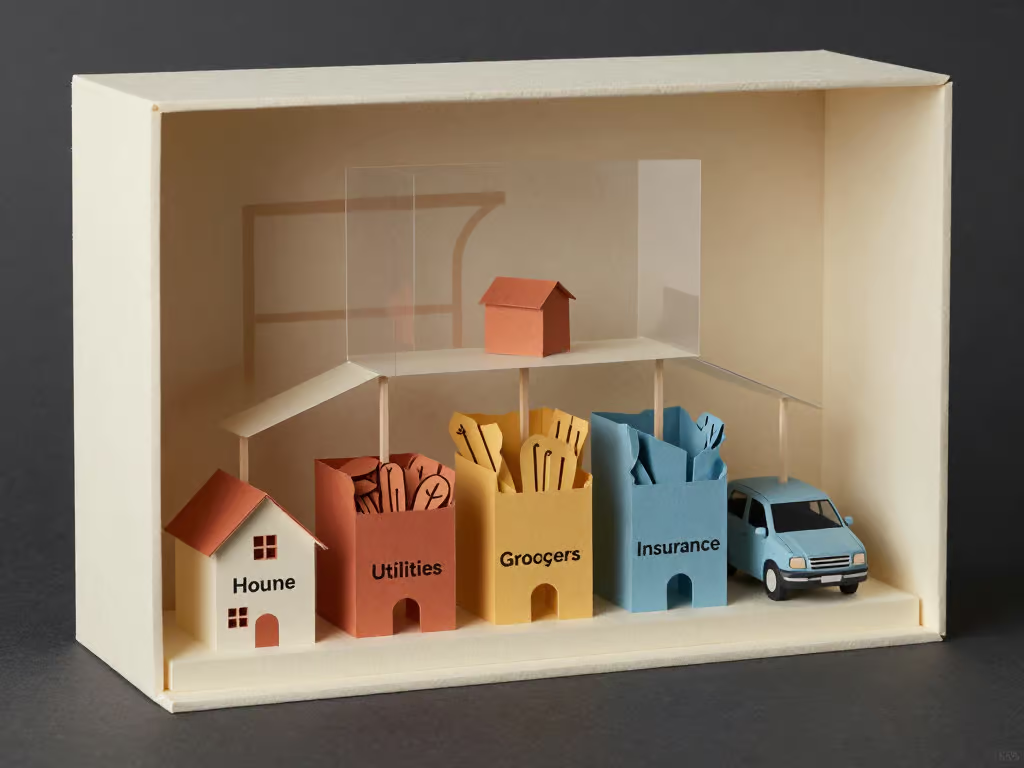
Putting essential costs at the front of your plan helps you stay afloat when money is tight. Focusing on housing, utilities, and groceries prevents small leaks from turning into big shortfalls and keeps your monthly budget on track.
Housing, utilities, and groceries strategies
- Housing: target housing costs at about 30, 40% of take‑home pay. For example, on a $3,000 monthly take‑home, aim for $900, $1,200 in housing expenses. If rates drop, consider refinancing to save hundreds per year; moving from 7% to 5.5% on a $300,000 loan could save about $4,000 in interest each year across a 30‑year term.
- Utilities: compare providers, use energy‑saving settings, and batch chores to lower peak usage. A quick win: run the dishwasher and laundry during off‑peak hours to cut bills by 10, 20%. Have a quick check for leaks and insulating improvements that pay back faster.
- Groceries: plan meals, shop with a list, and use unit pricing to compare products. When prices rise, buy non‑perishables in bulk and only stock up on items you will use within two months. Store loyalty apps and seasonal produce can shave 15, 30% off weekly totals.
Building a compliant needs list
- List fixed costs first: rent or mortgage, utilities, insurance, minimum debt payments, and transportation essentials.
- Set hard caps for each category based on income and limits on nonessential spending. For example, cap dining out at $150/month with a $4,000 take‑home, and move any surplus toward savings or debt payoff.
- Revisit the list monthly to keep needs within the plan and adjust if income changes or costs rise. Set a 3‑month review reminder and track actuals vs plan with a simple spreadsheet or budgeting app.
Automate bill payments and savings

Automating key money tasks helps you stay on track without constant manual effort. It reduces late fees, speeds up savings, and keeps your monthly budget and overall plan in sight, allowing you to better manage the money you make. With simple rules, you can see steady progress each month.
Setting up automatic transfers
Set automatic transfers from your checking to a savings or emergency fund every pay cycle. A practical approach is to move 10, 20% of your net pay the day after you’re paid, so the money never sits in your checking as discretionary.
- Start with a small, sustainable amount and raise it when possible without hurting essential bills.
- Open a separate high‑yield savings or a dedicated emergency fund account to avoid dipping into it for daily needs.
- Schedule debt payments automatically to prevent missed deadlines and penalties.
Calendaring and reminders
Use calendar reminders for due dates, budget reviews, and monthly checkups. A simple routine boosts discipline and prevents small costs from slipping through the cracks.
- Set reminders 3, 5 days before each due date to confirm funds are available and avoid overdrafts.
- Review your income and expenses once a month to confirm transfers still fit your goals.
- If you notice a recurring small expense you can cut, adjust the automation to redirect that amount toward savings to meet your short-term goals.
Create an emergency fund strategy

An emergency fund acts as your financial safety net. It helps you cover unexpected bills without derailing your monthly budget or taking on debt. Start small, then grow steadily to reduce stress when life throws a surprise.
Starting small, building to safety net
- Begin with a modest target, such as $500 to $1,000, to handle minor emergencies without panic.
- Then aim for 1 to 3 months of essential living costs, including housing and utilities, as your next milestone.
- Keep the fund in a separate savings account or a high‑yield option to earn a bit of interest while staying accessible.
Target timelines and milestones
- Milestone 1: $500, $1,000 within 1, 3 months, by directing small monthly savings into the fund.
- Milestone 2: 1 month of essential expenses within 6, 12 months, achieved by gradually increasing monthly contributions.
- Milestone 3: 3 months of essential expenses within 12, 18 months, aligning with life changes or income shifts.
Implement the 50/20/30 rule (modify for your situation)
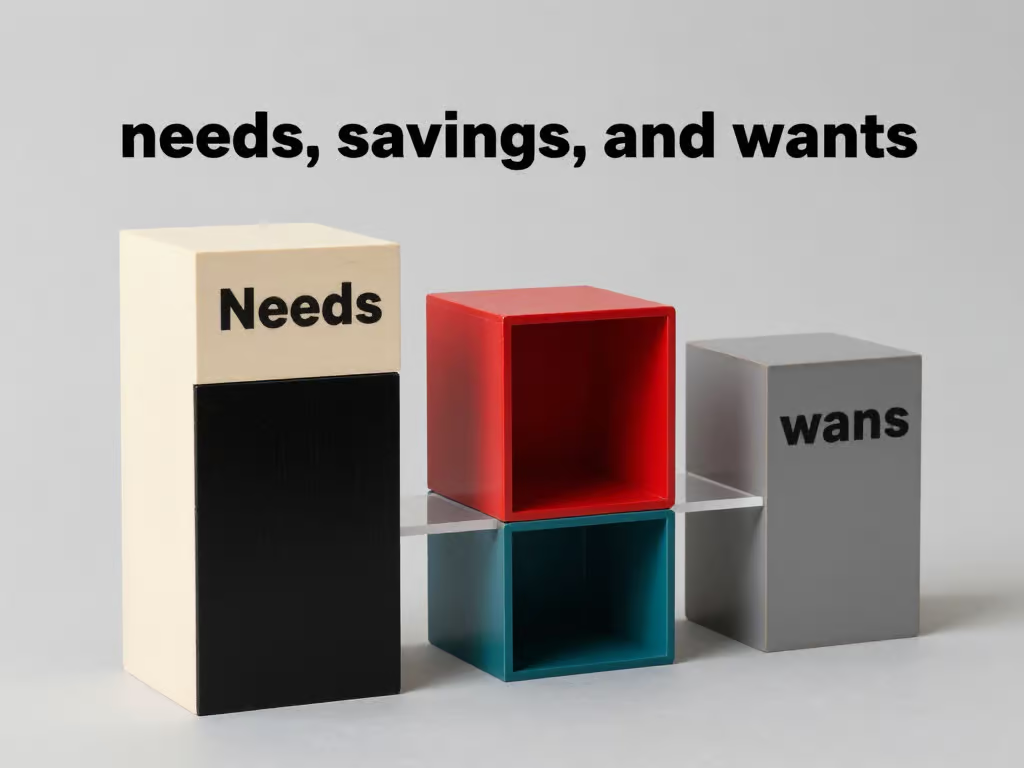
The 50/20/30 rule helps you divide income into three clear buckets: needs, savings, and wants. It’s a straightforward framework you can adjust to fit real life and goals.
Needs, savings, wants distribution
- NeedsEssential expenses you must cover, such as housing, utilities, groceries, and minimum debt payments, should be prioritized in your budgeting methods. For example, a $3,000 take‑home might allocate $1,500 for housing, $400 for utilities, $500 for groceries, and $200 for minimum debt.
- Savings: money set aside for future goals, including an emergency fund and retirement contributions. Practical steps: automate $300, $600 monthly into a high‑yield savings or retirement account, starting with an emergency fund of $1,000 and aiming for 3, 6 months of expenses.
- Wants: optional spending that improves quality of life but isn’t strictly necessary. Track a 2, 3 week spending log to identify nonessential patterns, then cap discretionary buys at 30% of take-home pay to help you use your money wisely.
Adapting percentages for income level
Low or volatile income may require a more flexible split. If needs take a larger share, you can adjust to 60/10/30 or 50/25/25 for a period while you stabilize. For instance, during a job transition, drop wants to 20% and boost savings to 25% to rebuild a buffer.
| Scenario | Proposed split: create a budget that aligns with your financial goals. | What to watch |
|---|---|---|
| Stable, middle income | 50% needs, 20% savings, 30% wants | Keeps long-term goals on track while preserving lifestyle without a budget. |
| Low income, essentials‑first | 60% needs, 10% savings, 30% wants | Prioritizes survival but still pushes small savings |
| High income, aggressive saving can help you achieve short-term goals more quickly. | 40% needs, 30% savings, 30% wants | Builds wealth faster without ignoring basics |
Use this as a starting point, then adjust monthly based on actual income and expenses. Regularly review and rebalance when life changes, like a raise or a shift in housing costs, to work toward your financial goals.
Cut common expense leaks without depriving quality
Small leaks in spending add up quickly. By trimming everyday costs while maintaining your standard of living, you can free up cash to save for retirement or work toward debt payoff without feeling deprived. This section offers practical steps you can start this month, with real world examples and quick wins.
Smart grocery tactics
Small changes at the store can lower your monthly food bill without sacrificing nutrition or taste. Try these practical moves that fit real life.
- Plan meals around weekly sales and unit prices, then write a shopping list from that plan. For example, stock up on sale ground beef when it’s $3.99 per lb and freeze portions for three dinners.
- Choose store brand staples for basics like bread, milk, yoghurt, and canned tomatoes, but keep a few trusted name brand items you actually use to avoid waste.
- Shop with a list and limit trips to avoid impulse buys; set a quick pre-shop timer to stay focused if you tend to wander the aisles without a budget.
Energy and subscription audits
Regular reviews of utilities and recurring fees keep ongoing costs in check. Use these steps to start now.
- Compare electric usage month to month and set a realistic goal, like cutting 8% of energy use in the next 30 days by tweaking thermostat and laundry temps.
- Turn off lights when leaving rooms, switch to LEDs, and unplug rarely used devices to prevent phantom charges; use a smart plug to identify idle machines.
- Audit subscriptions by category (streaming, apps, tools) and cancel or downgrade any you rarely use; consider a family plan or annual billing if it saves money.
| Leak area | Low-cost fix | Potential monthly saving |
|---|---|---|
| Groceries | Plan meals, buy generics, batch cook | $25-$70 |
| Energy | LED bulbs, smart scheduling, unplug idle devices | $15-$50 is a common budgeting range for small, discretionary expenses. |
| Subscriptions | Cancel unused services and switch to cheaper plans to effectively spend your money more wisely and try to save. | $5-$40 |
Track these small wins over 6, 8 weeks to see how they impact your monthly budget and savings goals.
FAQ
Here are practical answers to common questions about budgeting and saving money, using plain language and concrete steps. The full article title is included earlier, and this section adds real-world steps you can start tonight to build your plan.
- What is a budget? A budget is a plan that shows how you will spend and save money each month. It helps you track income and expenses so you can reach savings goals. Real-world example: A successful budgeting methods implementation can lead to significant savings. if you bring home $3,500, list fixed costs ($1,800 rent, $200 phone) and variable costs ($400 groceries, $150 gas), then earmark $350 for savings and $600 for discretionary spending.
- How much should I save each month? A simple starting point is to aim for at least 10, 20% of your take-home pay, then adjust based on your personal budget. monthly expenses and emergency fund needs. Actionable tip: Automate 15% if you can, and review after 30 days for adjustments when you get a raise or lower bills to determine how much to save.
- What is zero-based budgeting? It means every dollar of income is assigned to a category, so your income minus spending equals zero at the end of the month. This reduces waste and clarifies priorities. Practice tracking your spending to better manage your finances. assign categories before the month starts, including a small cushion for irregular bills like car maintenance.
- How can I build an emergency fund fast? Start with a small target, like one paycheck or $500, then add a fixed amount each month until you reach 3, 6 months of essential expenses. Concrete plan: Set a weekly $25 transfer if you’re paid biweekly, and bump it by $10 whenever you get a lump sum bonus to help save for retirement.
- Should I automate savings? Yes. Set automatic transfers to a savings account right after you receive your paycheck To avoid the temptation to spend first, consider using a credit union for better savings options. Edge case: if your employer offers a take-home pay split, use the savings portion as a separate transfer from the paycheck rather than catching up later.
- What if I have a tight budget? Focus on essential needs first, then gradually add small savings contributions as you identify ways to save money. Simple steps: cancel unused subscriptions, switch to cheaper energy plans, and cook at home 4 nights a week to free up $50, $100 monthly.
Conclusion
Steady progress comes from a clear plan and small, consistent actions to try to save effectively. A well designed budget helps you see where money goes, set realistic savings targets, and stay aligned with your financial goals.
By applying zero-based budgeting, tracking every dollar, and prioritizing essentials, you build a solid foundation for emergency funds and long term savings. Automations and regular reviews keep the plan on track without extra effort.
Key takeaways to finish strong:
- Make a budget that covers fixed expenses, bills, and essentials first.
- Use a savings account to separate funds for emergencies and long term goals.
- Review your budget monthly to adjust for life changes and new priorities.
If you want a simple rule to start, save consistently from each paycheck and look for at least one area to tighten every month. That habit, more than any single change, moves you toward financial stability.